liveBook · Manning

Symbolic reasoning

As explained in Natural Language Processing in Action, Second Edition

Symbolic reasoning is an artificial-intelligence technique that derives conclusions by manipulating explicit symbols, facts, and logical rules.

Symbolic reasoning derives conclusions by manipulating explicit symbols, facts, and logical rules. In an NLP pipeline, it complements probabilistic models by grounding language in facts that can support more reliable inferences. section 11.0 section 11.1

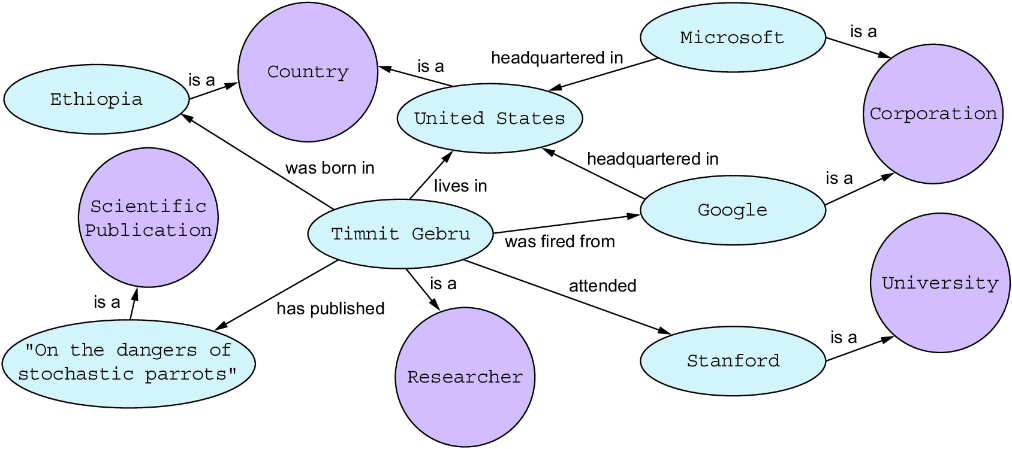
A knowledge graph stores facts about a chosen world, while a natural-language dependency tree exposes logical relations in text. Together, they separate reasoning from language generation: a language model can produce fluent text while symbolic structures constrain whether its claims are correct. section 11.0 section 11.1

The approach connects several ideas:

  • Treats a dependency tree as analogous to a compiler parse tree or abstract syntax tree for extracting relations. section 11.0
  • Contrasts symbolic reasoning with probabilistic reasoning used by machine-learning models. section 11.1
  • Uses first-order logic and GOFAI as established symbolic approaches, now combined with neural methods. section 11.1
Figure 11.1 An example of a knowledge graph
figure

Inspect a knowledge graph to see how explicit facts provide a substrate for symbolic inference. section 11.0


How Natural Language Processing in Action, Second Edition covers it

How deep it goes
Contrasts symbolic and probabilistic reasoning, names first-order logic and GOFAI, and sketches dependency-tree-based grounding.
Examples
Uses knowledge graphs, natural-language dependency trees, compiler parse trees, and abstract syntax trees as concrete reference points.
What you can do after
Apply knowledge graphs to separate reasoning from language generation and make model explanations more fact-grounded.
How it connects
Connects knowledge graphs, information extraction, dependency parsing, first-order logic, GOFAI, and neural language models.

Also explained in

Compare how 3 books explain symbolic reasoning →

Related concepts

This explainer was generated by Manning's knowledge graph from the text of Natural Language Processing in Action, Second Edition. The section links point to the parts of the book it draws on.
