A synapse is a specialized junction through which a neuron communicates with another neuron or target cell. Neurotransmitters cross this junction, carrying signals from an axon terminal to receiving structures such as dendrites. Each neuron can form thousands of connections, creating an extensive communication network in the brain. section 6.1.1
Synapses are changeable rather than fixed. Repeated signaling can strengthen a connection, while learning can alter the brain’s electrochemical pathways and help create new synaptic connections. This physical adaptability links synapses to memory formation and distinguishes biological neural networks from the simpler weight-based learning of artificial neural networks. section 6.1.1 section 6.1.2
Learning and memory in sea slugs
Eric Kandel’s experiments with the simple nervous system of sea slugs showed that learning involved chemical changes in the synaptic network connecting cells. These changes in electrochemical signaling were associated with the formation of new memories. section 6.1.2
Figure 6.1 Image of a typical neuron (courtesy of Wikimedia Commons, CC BY-SA 3.0)
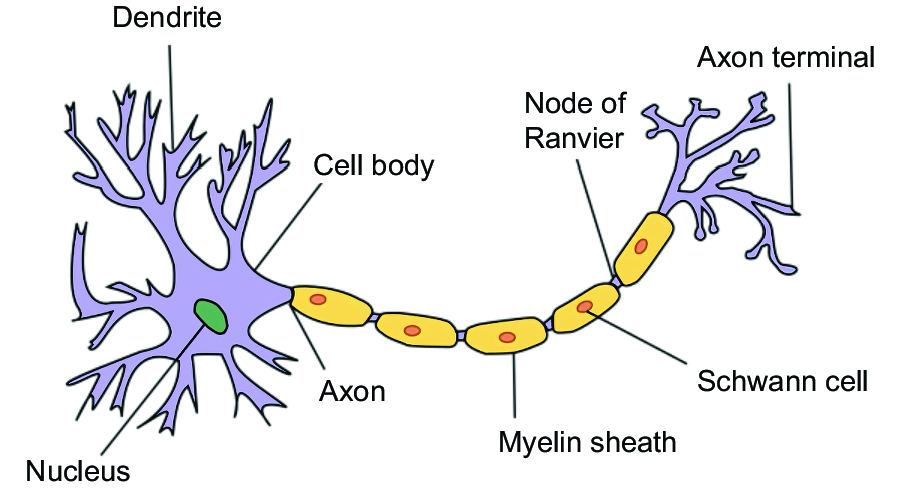
Use the neuron diagram to identify the cell body, axon, dendrites, and the structures involved in synaptic communication. section 6.1.1
