A writing assistant can produce a plausible sentence from a short prompt. That is where current large language models are strongest: syntax, the rules for arranging words into phrases and sentences. Fluent wording is useful, but it does not by itself establish that a response fits the real-world situation. section 2.4 section 2.5
The distinction helps set expectations for a product:
- Writing assistants and chatbots fit short-context text generation well. section 2.4
- A shopping assistant also needs facts about products, stores, and prices. A database can supply that context through prompting; it does not give the model an internal system for understanding the situation. section 2.4
- A chess bot is a harder proposition: familiarity with common move notation does not make an LLM good at playing chess. section 2.4
Syntax is one part of language, alongside phonetics, semantics, pragmatics, and morphology. Embeddings approximate semantic information, while prompting or connected databases can provide situational context. These additions can help a model generate an appropriate-looking response, but fluent syntax should not be mistaken for a complete account of meaning or context. section 2.1.1 section 2.4
Figure 2.9 How difficult or easy certain tasks are for LLMs and what approaches to take to solve them
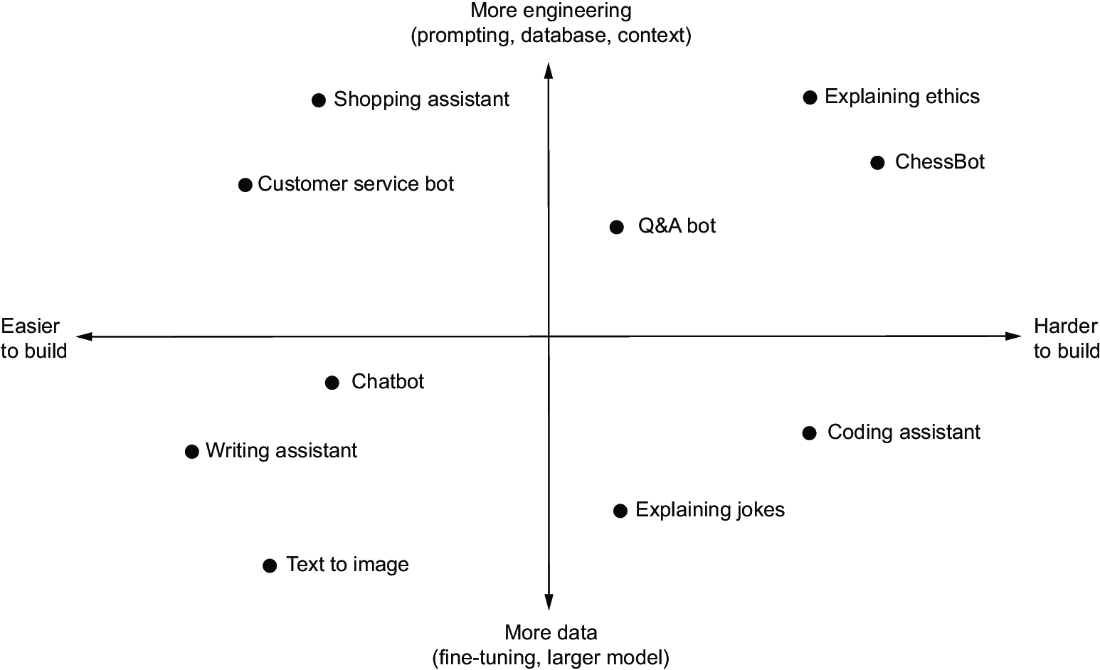
Compare the illustrated LLM tasks by difficulty before deciding whether short-context text generation is enough or additional context is needed. section 2.4


