An AI agent can produce locally correct code that is systemically wrong. System context is the persistent information about a software system’s architecture, schemas, service topology, and cross-service relationships that helps the agent work beyond a single project. section 10.1 section 3.5.3
A locally correct authentication change
An agent working in payment-service has source files, tests, and project instructions, but does not know that a shared authentication path was deprecated after a security incident. It generates a clean authentication flow using the deprecated pattern. Project context alone did not expose the system constraint. section 10.1
System context forms the base of a broader context fabric. Code conventions, organizational rules, historical decisions, and operational records add useful layers, but cannot compensate for a missing understanding of where services fit. Capture knowledge that otherwise lives only with people in artifacts agents can load across sessions. section 3.5.3
Figure 3.11 The context pyramid: five interdependent layers of the Context Fabric. Each layer rests on the ones below it - a gap low in the pyramid undermines everything above, no matter how complete the upper layers are.
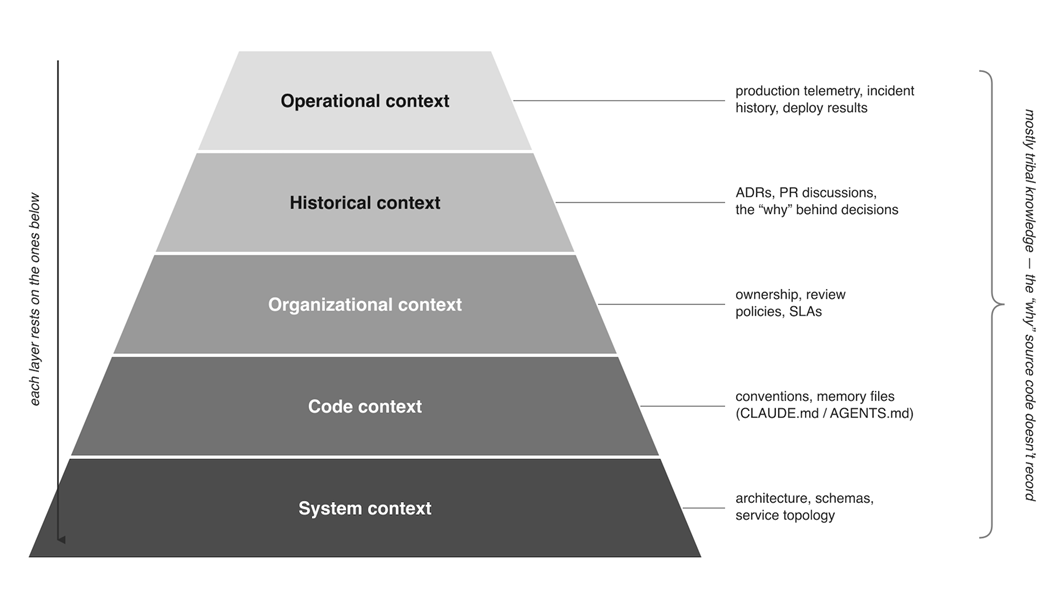
The context pyramid shows system context beneath the other interdependent knowledge layers. section 3.5.3
Delivery matters as much as collection. Too little context leaves agents unaware of constraints; too much can overwhelm them. Repository boundaries influence how easily relationships become visible, while task-specific tool selection can limit the options an agent must navigate. section 10.1
Curate tools before the task
Stripe found that exposing more than 400 internal MCP tools overwhelmed its agents. Its deterministic orchestrator instead selects roughly 15 relevant tools per task before generation begins. The lesson is to deliver the context and tools a task needs, not the entire available inventory. section 10.1

