A system operation is an invokable slice of an application’s externally visible behavior. Applications implement operations and may publish events as a result of executing them. Users, other applications, incoming events, or the passage of time can trigger an operation. section 3.1.1
Operations take two forms:
- Commands mutate data, as with createOrder() or cancelOrder(). section 3.1.1
- Queries retrieve data, as with findOrderHistory(). section 3.1.1
An operation may be handled by one subdomain and enlist others. For example, Order Management can handle createOrder(), then use Consumer Management to verify eligibility and Delivery Management to schedule delivery. In a microservice architecture, operations that span services are more complicated than local ones and can constrain service boundaries. section 3.2.1 section 7.2
FTGO order operations
createOrder() and cancelOrder() are commands; findOrderHistory() is a query. Events such as Order Created or Order Cancelled can notify users or other applications after operations execute. section 3.1.1
Figure 3.1 An application, such as FTGO, implements system operations - invoked by users, other applications, and the passing of time - and publishes events, which are the result of executing operations, and are subscribed to by other applications and users
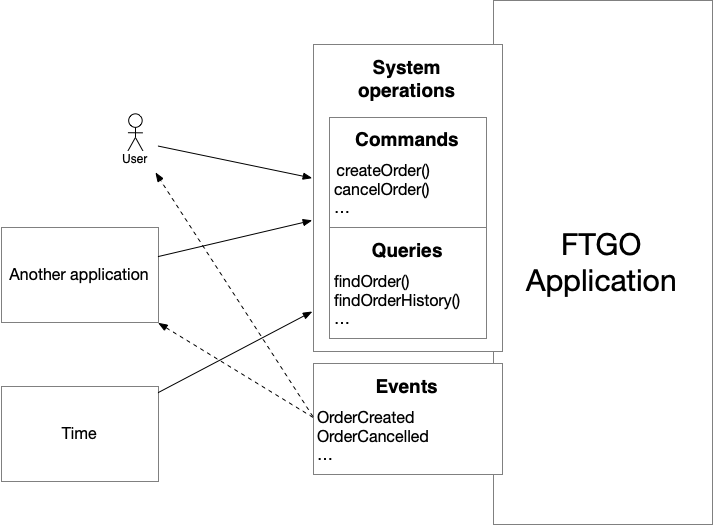
Shows operations invoked by users, applications, and time-based processing, with resulting events delivered to subscribers. section 3.1.1
