Tail-call optimization (TCO) makes certain recursive programs use the stack more like a loop. When the final operation is another function call, the runtime can discard the current frame instead of stacking a new one. section 7.4
A recursive call can use TCO when:
- The recursive call is in tail position: it is the last operation, with no multiplication, addition, or other work remaining afterward. section 7.4
- The function passes necessary state through arguments, often using an accumulator. section 7.4
- The compiler or runtime reuses a single execution frame rather than allowing recursive frames to accumulate. section 7.4
Accumulator-based factorial
const factorial = (n, current = 1) => (n === 1) ? current : factorial(n - 1, n * current); Each call carries the result accumulated so far. The recursive call is the final action, so evaluating factorial(4) can proceed through successive argument values instead of building a pyramid of pending multiplications. section 7.4
Figure 7.9. A detailed view of tail-recursive factorial(4) evaluation. As you can see, the function uses a single frame. TCO is in charge of throwing the current function frame to give way for a new one, as if factorial was being evaluated in a loop.
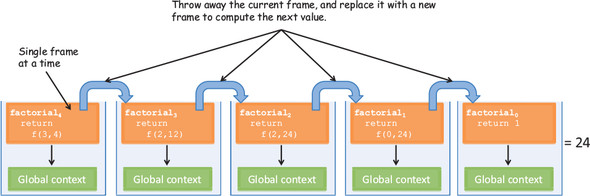
Shows tail-recursive factorial evaluation using a single reusable frame, making the stack benefit visible. section 7.4


