liveBook · Manning

Target function

As explained in Build AI Drug Discovery Pipelines

A target function is the unknown input-output mapping that defines the true outcome of a prediction task.

A target function is the unknown ground-truth mapping f: X→Y from possible inputs to their true outputs. In drug discovery, X can be the chemical space of druglike compounds, while Y records whether each compound blocks hERG. section 3.3.1

A machine-learning workflow approximates the target function:

  • Represent compounds with molecular descriptors, structural fingerprints, or other numerical features. section 3.3.1
  • Learn model weights from experimentally labeled pairs such as (compound, hERG activity). section 3.3.1
  • Use loss, cost, and learning routines to reduce prediction error, then freeze the weights for inference. section 3.3.1
Figure 3.7 We can formally define our problem as a mathematical function, f∶ X→Y, that maps the set of all possible inputs, X (the full chemical space of druglike compounds), to the set of all possible outputs, Y (“yes” or “no” to hERG blocking).
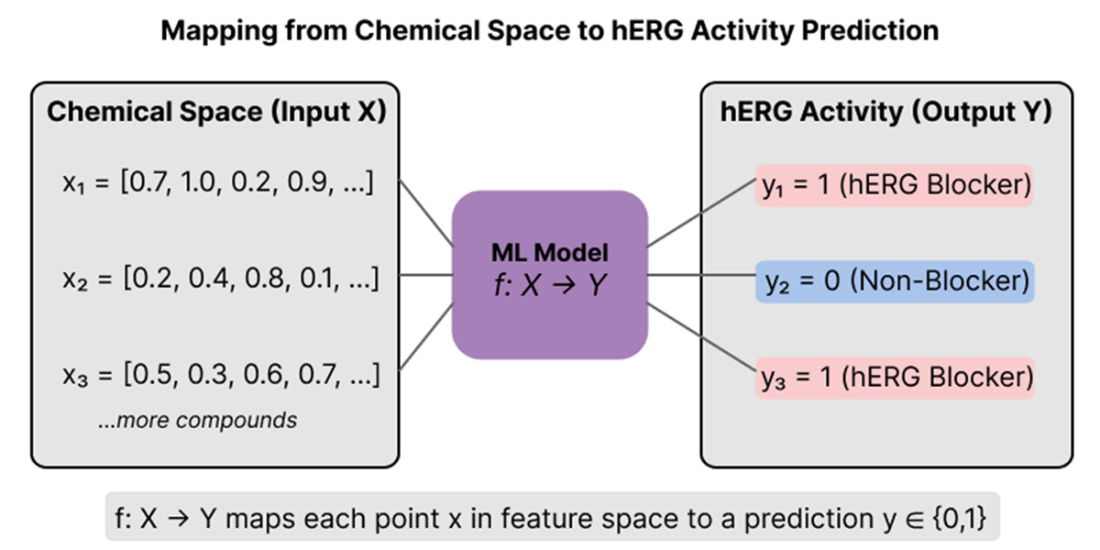
Visualizes the mapping from the full chemical space to hERG-blocking outcomes. section 3.3.1


How Build AI Drug Discovery Pipelines covers it

How deep it goes
Defines the mapping and connects it to training, optimization, generalization, and frozen-weight inference.
Examples
Uses molecular features and experimentally determined hERG-blocking labels for druglike compounds.
What you can do after
Evaluate/understand how trained models approximate biological ground truth and generate predictions for unseen compounds.
How it connects
Connects target functions to training datasets, model weights, loss functions, cost functions, optimization, and inference.

Also explained in

Compare how 3 books explain target function →

Related concepts

This explainer was generated by Manning's knowledge graph from the text of Build AI Drug Discovery Pipelines. The section links point to the parts of the book it draws on.
