A target register is the collection of qubits that carries the state being acted on, counted, or amplitude-estimated. It is paired with an estimation register, whose measured value encodes a phase or probability estimate. section 9.3 section 9.6.1
Use the target register to:
- Prepare an eigenstate of a circuit U for quantum phase estimation. section 9.3
- Receive controlled applications of U or the Grover iterate, repeated 2^k times from estimation-register controls. section 9.3 section 9.6.1
- Carry the equal-superposition search space whose oracle-marked outcomes are counted. section 9.6.2
Quantum counting register layout
Create a three-qubit target register and a five-qubit estimation register. Apply a uniform-state preparation circuit to the target register, then use an oracle marking outcomes 0, 1, and 2. Controlled Grover iterations act on the target register; the estimation register is measured to infer that three outcomes are good. section 9.6.2
Figure 9.27 The amplitude estimation diagram where A is an m-qubit circuit and G is a Grover operator constructed using an m-qubit oracle circuit
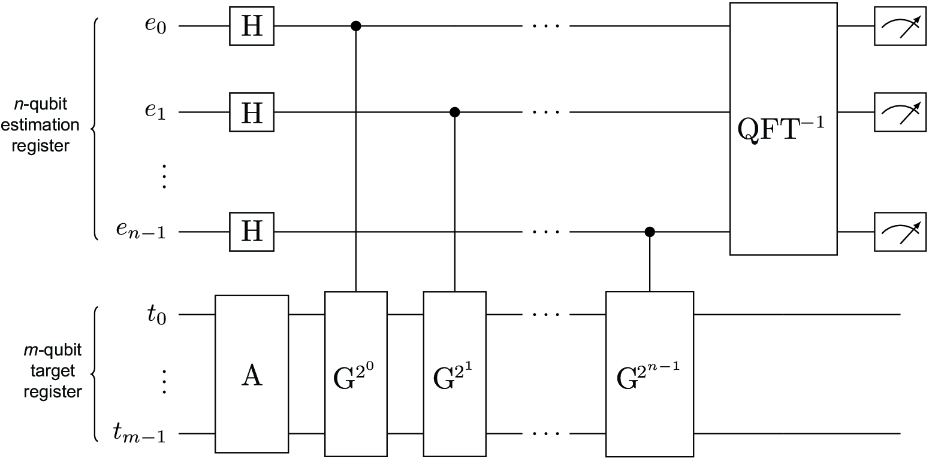
The circuit diagram shows how the target register connects to the estimation register and controlled Grover iterates. section 9.6.1
