A single agent asked to reason across a sprawling archive may miss details even when the input fits its context window. It may also choose the wrong tool or make a consequential change without enough experimentation. Decomposition addresses these limits by dividing work into smaller units whose inputs, responsibilities, and outputs can be controlled more closely. section 3.1 section 8.0
Two useful boundaries are the workflow and the input:
- Split an agent workflow into flow-controlling components, which decide what runs next, and action-performing components. A leaf action can be an errand: a focused intelligent subroutine with unidirectional information flow and no direct effect on agent state. section 3.1 section 3.5
- Split a large input using Decompose-Process-Recompose (DPR). Divide it into fitting fragments, process each fragment, then combine the intermediate results into one answer. The decomposition should preserve the information needed for recomposition. section 8.2
Figure 8.1 The AFD of the DPR pattern. The input is first decomposed into fragments. Each fragment is then fed to an instance of the processor IE, which produces an intermediate result per fragment. The intermediate results are then gathered and passed into the recomposer, which produces the final result.
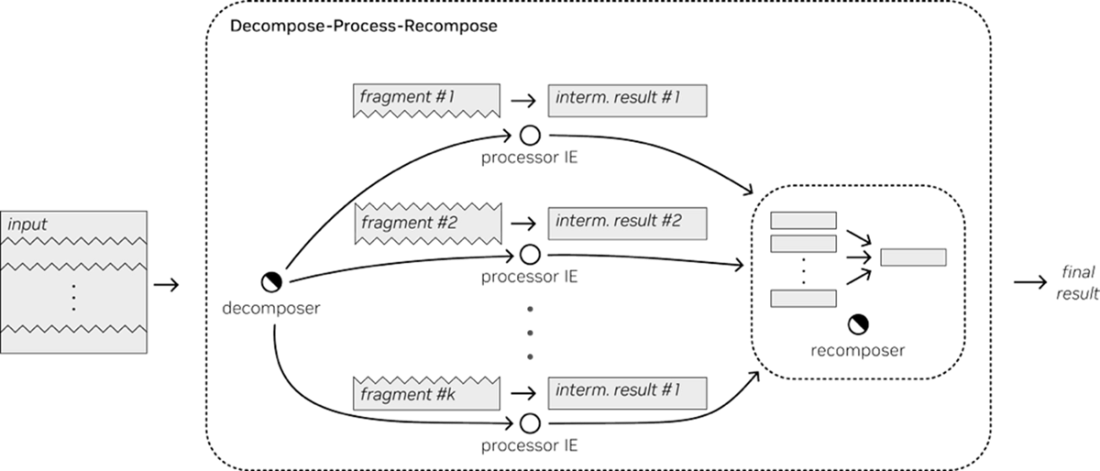
The data-flow diagram makes the DPR boundary explicit: fragments go to processor instances, and their intermediate results converge at a recomposer. section 8.2
Processing a large archive
For an archive too large for reliable direct analysis, partition the input into manageable fragments, run the focused operation on each, and recompose the results into a global answer. Map-reduce document summarization is one application; recomposition should not leave the final answer looking like disconnected fragments. section 8.0 section 8.2 section 8.5
The trade-off is orchestration and cost. Separate errands can improve focus, testing, maintenance, and parallel execution, but repeated shared context across model calls adds overhead. Input decomposition likewise needs a recomposition step; merely splitting work does not produce a coherent final result. section 3.2.1 section 3.5 section 8.2