A task organizer ensures that collaborative-session tasks are assigned to individuals or subgroups, tracked, and followed through. The role creates an explicit contract with task owners without taking responsibility for the group’s outcome. section 5.1.2
Use the stance to keep collaborative work moving:
- Track to-dos on a whiteboard so ownership and progress remain visible. section 5.1.2
- Review and update task progress for a few minutes during each session. section 5.1.2
- Use the enabler stance to uncover and remove roadblocks by asking what prevents progress or what help is needed. section 5.1.2
- Treat the role as one facilitator stance among several, informed by observation and usable alongside coordination, coaching, and counseling. section 5.1
A visible follow-through loop
After a collaborative modeling session, record each to-do beside its individual or subgroup owner. At the next session, review each item, update its progress, and ask, “Is there anything preventing you from moving forward with this?” section 5.1.2
Figure 5.1 The facilitator takes on different stances. The observer stance takes a central place, which provides a facilitator with important information to take on other stances.
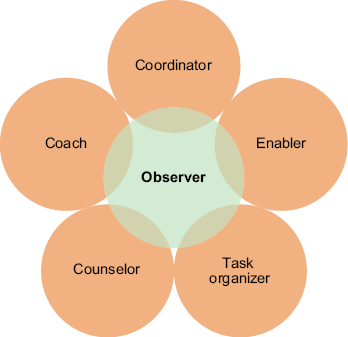
Use the stance map to see task organization as part of a wider facilitation practice centered on observation. section 5.1
