TCP is a connection-oriented transport-layer protocol for reliable, ordered byte streams. In Go applications, it provides the network connection beneath many web and custom-server workloads, with built-in handshaking, error detection, acknowledgements, and reconnection support. section 7.2 section 7.0
A TCP exchange typically follows this operational pattern:
- The application opens a connection between a client and server. section 7.2.2
- The client sends messages through the connection, while TCP handles network-level responses that application code does not directly expose. section 7.2.2
- TCP may split one application message across multiple packets; the receiver acknowledges each received packet. section 7.2.2
- Applications must still address dropped connections and slow receivers, often by buffering data and making logging or delivery more resilient. section 7.2.2
Network logger
A logger opens a TCP connection to a remote logging service, sends log messages, and closes the connection. If the network or receiver fails, or transmission slows, buffering helps prevent lost messages and service failures. section 7.2.2
Figure 7.1 Sending messages over TCP, with a sequence of commands between a client (App) and server (Logger). First we connect; then an acknowledgement (Ack) is sent to the connection as well as to each message.
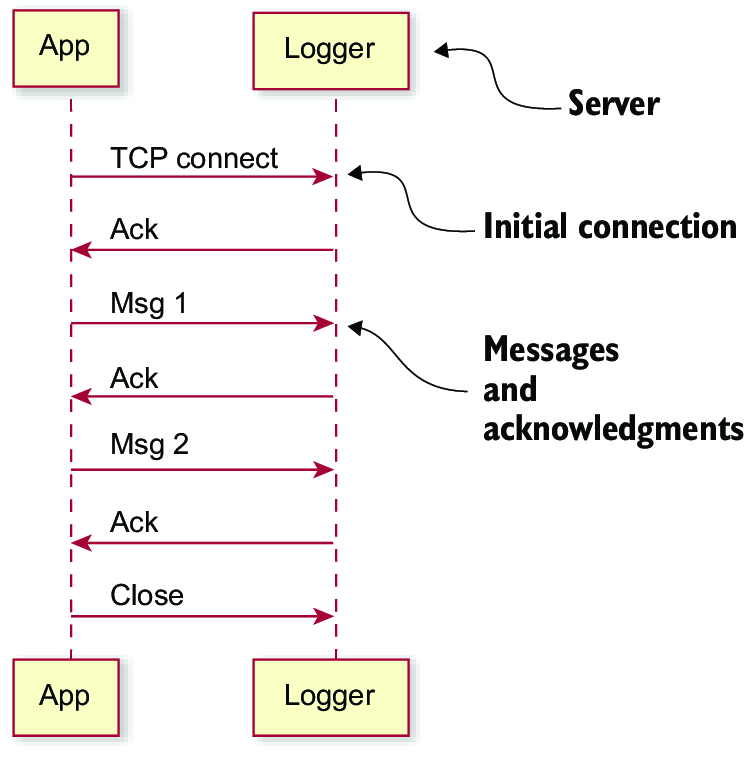
Trace the client–server command sequence: connection establishment, acknowledgements for the connection and messages, and subsequent data exchange. section 7.2.2
TCP supports custom servers, log storage, and multiplexed communication. WebSockets extend persistent connections for longer-lived bidirectional exchanges, while standard HTTP remains the most common application approach over TCP. section 7.5




