The TCP/IP protocol suite is a practical, layered framework for moving information between applications, devices, and networks. It provides the foundation for the Internet and helps security professionals understand where communication risks and controls arise. section 11.0 section 11.6
Organize the suite into four layers:
- Application: determines which protocols applications use. section 11.12
- Transport: allows data to move between devices and supports TCP connection establishment through the SYN, SYN/ACK, and ACK handshake. section 11.12
- Internet: creates and inserts packets for routing across networks. section 11.12
- Network Interface: governs how data moves through the network. section 11.12
Unlike the seven-layer OSI model, TCP/IP groups related functions into fewer layers and does not include a separate Physical layer. This makes it more practical and adaptable while still providing a way to reason about data movement, performance, and vulnerabilities. section 11.6 section 11.12
Everyday protocol examples
A device may use IP addressing for routing, SMTP on port 25 to send email, or HTTPS on port 443 to protect web communication with SSL/TLS. DHCP and DNS help assign addresses and resolve domain names. section 11.12 section 11.9
Figure 11.9 A side-by-side illustration of the layers of the OSI and TCP/IP network stack models
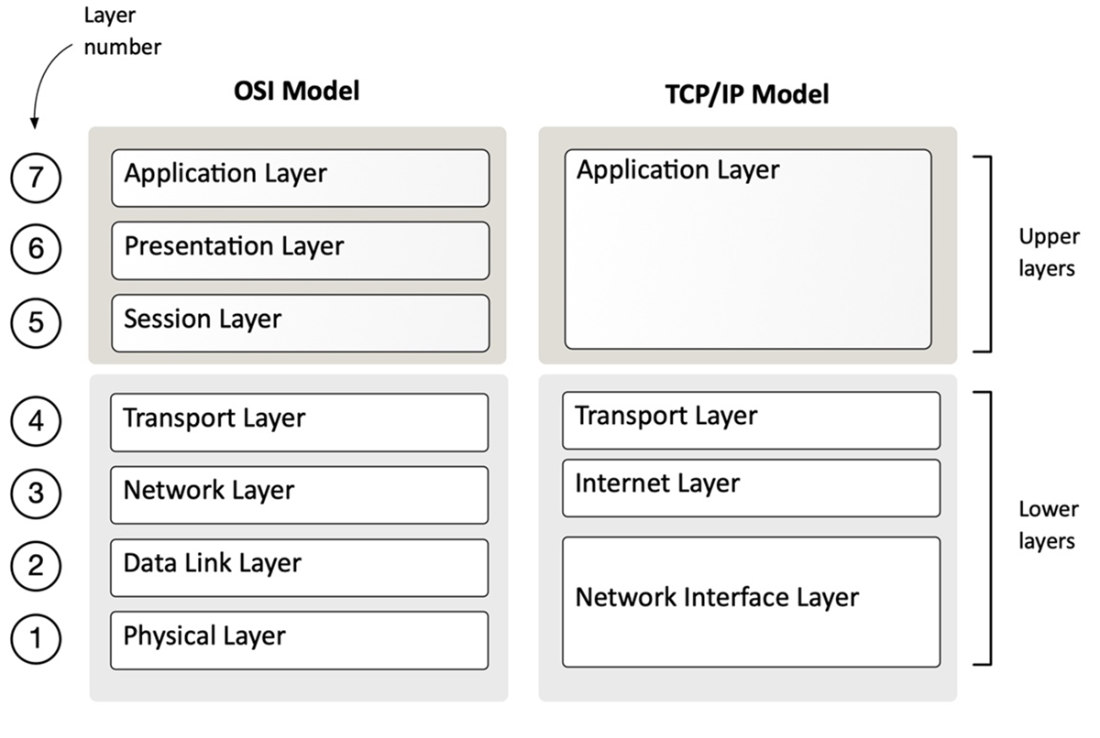
Compare the OSI and TCP/IP layers side by side to see how TCP/IP groups networking responsibilities. section 11.6


