A technology stack is the set of technologies used to build and run an application. It includes specific versions of languages, runtimes, frameworks, libraries, infrastructure services, development tools, and deployment technologies. An application can contain multiple versions of the same technology. section 5.3.1
Stack choices affect how easily teams can change an application. A monolith generally uses one language runtime and supporting libraries, limiting the choice of technologies for individual subdomains. Upgrading a shared runtime or dependency can affect the entire application and compete with feature delivery. section 6.1.3 section 2.1.3
In a multi-component application, each component can have a private stack, while other technologies are shared. Private technologies can include a runtime, frameworks, libraries, development tools, and a database; a message broker can be shared across components. section 5.3.1
Figure 5.8 An application’s technology stack consists of libraries, frameworks, programming languages, infrastructure services, development tools, and deployment environments. Some technologies, such as languages, libraries and some infrastructure services, are private to components. Other technologies might be shared between components, such as message brokers.
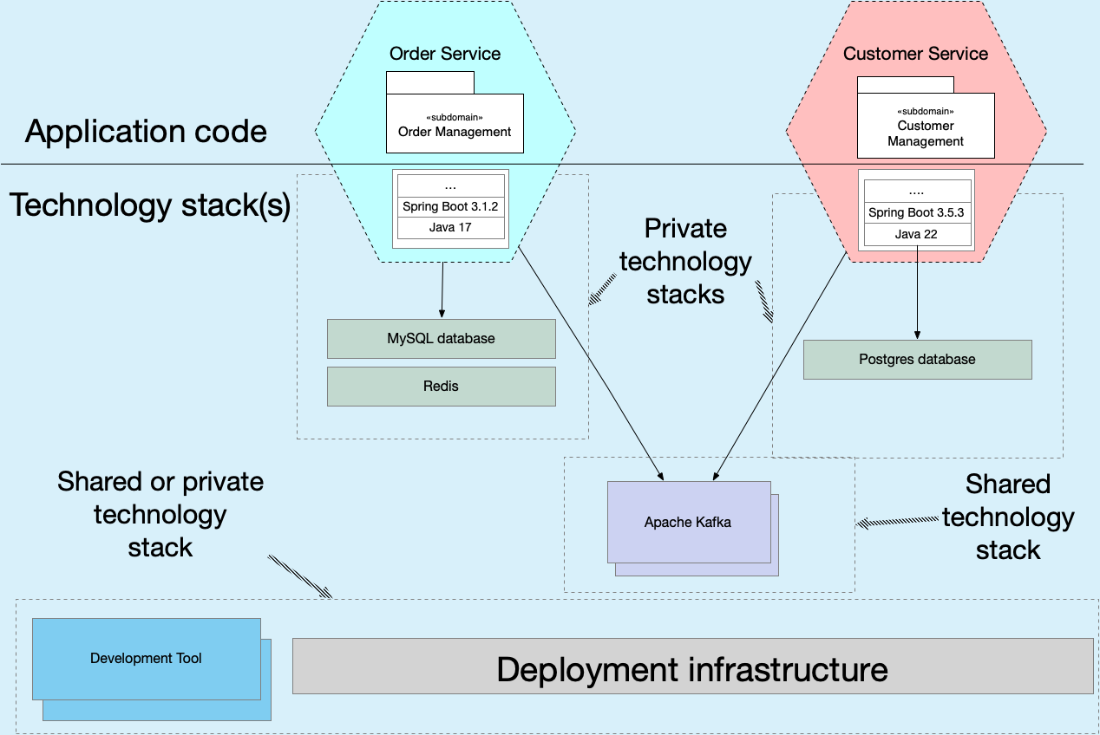
Use this diagram to distinguish component-private technologies from infrastructure shared across components. section 5.3.1
Different service stacks
A Customer Service uses Java 22, Spring Boot 3.5.3, and Postgres, while an Order Service uses Java 17, Spring Boot 3.1.2, and MySQL. The Order Service also uses Redis for caching. The services can therefore use different technology versions and meet different needs. section 5.3.1
Separate services let teams choose technologies suited to each job, upgrade one service at a time, and try a new stack on a limited scale. For example, an organization might use Java for most services and Python for AI-related services. If an experiment fails, the team can reimplement that service with a proven stack. section 1.3.3 section 7.4.2
Choice still needs governance: manage the set of approved technologies rather than allowing unrestricted variation. Multiple stacks alone do not justify microservices; distributed operations introduce challenges including latency, partial failure, and eventual consistency. Weigh stack flexibility against those costs. section 7.4.2 section 7.7






