TensorFlow is an open-source platform for building and executing machine-learning computations, including neural networks. In tabular-data workflows, it serves as the low-level deep-learning framework beneath Keras. section 8.1
A practical TensorFlow stack separates framework responsibilities from model-building code. Keras supplies the recommended high-level API, while TensorFlow executes the underlying deep-learning workflow. section 8.1
TensorFlow is positioned alongside several alternatives for deep learning with tabular data:
- TensorFlow is used more frequently in industry, while PyTorch is predominant in research. section 8.7
- Keras abstracts aspects of TensorFlow; comparable higher-level options include fastai and Lightning Flash for PyTorch. section 8.7
- TensorFlow supports tabular libraries such as SAINT, while TabNet is available for both TensorFlow and PyTorch. section 8.7
Airbnb listing price classification
A TensorFlow-and-Keras model can accept multiple inputs—one for each selected Airbnb listing column—and produce one prediction: whether the price is above or below the median. Model code defines layers for categorical, continuous, and text inputs; categorical inputs can use embedding and batch-normalization layers. section 8.1
Figure 8.2 The stack for the Airbnb NYC solution in chapter 3
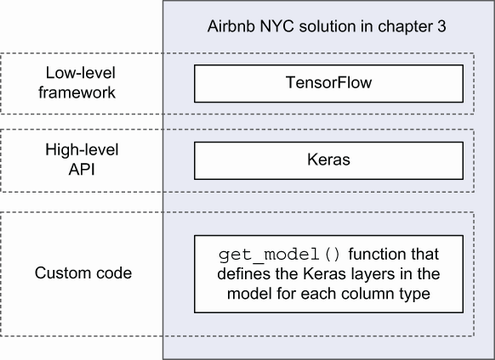
The stack diagram helps separate TensorFlow's low-level role from Keras and the model components used in the Airbnb workflow. section 8.1



