Test planning prepares how software testing will be conducted by identifying the product and project risks that testing should define and mitigate. It may appear as informal notes, acceptance criteria, a one-page plan, or formal documentation. section 5.1 section 5.5
A risk-focused planning process can:
- Identify specific, measurable risks for a feature, epic, or project. section 5.1
- Use those risks to decide what types of testing and test ideas are needed. section 5.1
- Break a system or feature into meaningful parts with visual or mental models. section 5.5
- Create focused prompts that ask an LLM for suggestions about specific system parts rather than generic test suites. section 5.3 section 5.5
- Review generated risks and test cases skeptically, treating LLM output as assistance rather than authority. section 5.4.1
Focused planning prompt
Instead of asking an LLM to generate every test for a project, first model a specific feature or system segment, identify the risks that matter, and request test ideas for that part. Evaluate the suggestions for relevance, omissions, and potential monoculture before using them. section 5.3 section 5.4.1
Figure 5.1 A diagram showing the relationship of risk and test planning
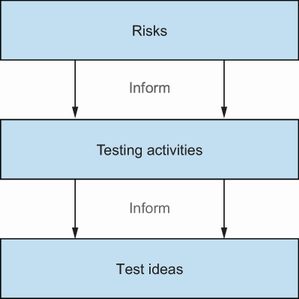
Use the risk-and-test-planning relationship as a navigation model for connecting identified risks to planned testing. section 5.1
