Testability is how quickly and easily a change can be verified as releasable. It supports fast flow by shortening both developers’ edit-test-analyze loops and the deployment pipeline’s feedback cycle. section 5.0 section 5.4
Design for testability across three dimensions:
- Automatable: verify behavior with automated rather than manual tests. section 5.4.2
- Fast-running: return feedback quickly during development and in the deployment pipeline. section 5.4
- Local: let developers run tests on their own machines without a separate test environment. section 5.4.2
Architecture affects whether tests are straightforward to write and quick to run. Modularity, loose design-time coupling, and determinism support high testability. Small, independently testable services can verify behavior with local automated tests rather than relying on complex, slow end-to-end tests. section 5.7 section 7.4.1
Set measurable feedback targets
For an Orders team changing a business rule, tests run during development complete within 2 seconds, local pre-commit tests within 1 minute, and pipeline tests within 10 minutes. These targets make testability requirements concrete. section 5.4.1
Figure 5.13 Fast flow requires an architecture that is testable: software elements must be tested using fast running automated tests that run locally on a developer’s laptop.
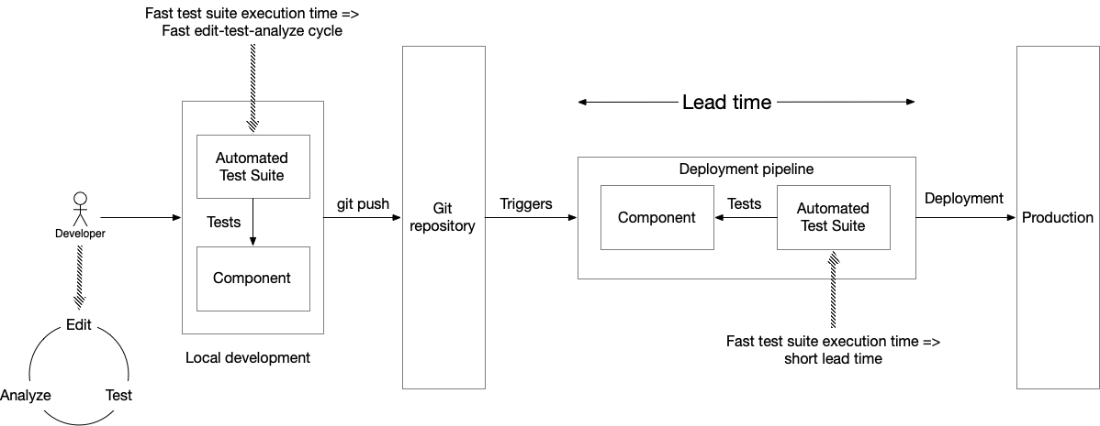
Use the figure to see the three testability dimensions together: automated tests that run quickly and locally. section 5.4.2






