Text-to-speech conversion turns written text into synthesized speech that a user can hear. In a voice-support system, it reads an LLM’s text output aloud. section 8.3 section 8.3.2
A voice interaction can connect several stages:
- Speech-to-text transcribes the caller’s words into input for an LLM. section 8.3.2
- The system produces text, then text-to-speech converts that output into something the caller can hear and understand. section 8.3.2
- A bail-out mechanism lets callers leave automation when the system cannot understand or solve the problem. section 8.3.2
Customer support by phone
A caller describes a problem while waiting, receives an automated spoken response based on a known solution, and can transfer to a human analyst if it fails. section 8.3 section 8.3.2
Figure 8.5 This diagram describes our “better solution” to customer support requests, where customers describe their problem while waiting to talk to someone. The LLM uses an embedding representation of the problem to compare similar problems with known solutions. While the user waits, an automated system can provide information that may help them solve their problem without support personnel intervention. If that fails, there’s always the possibility to “bail out” and talk to a real person. The model used to generate the embeddings does not necessarily have to be the same as the LLM that walks the user through the solution.
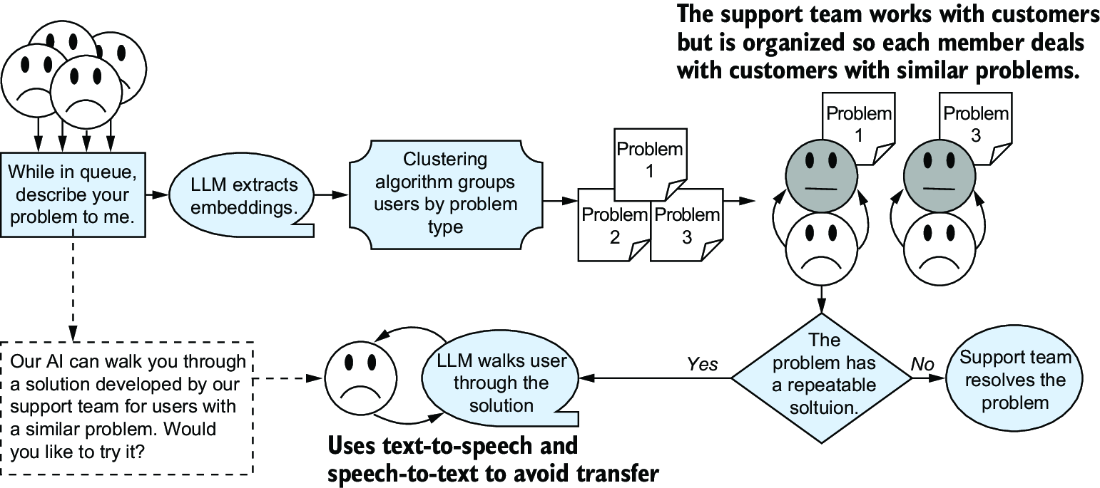
Trace the support design from a caller’s problem description through embeddings, known solutions, spoken guidance, and human escalation. section 8.3.2



