A team asks for visible reasoning in a tense meeting, but answers turn guarded and assumptions stay hidden. The thinking environment is the social, cognitive, informational, and temporal conditions that shape whether people can expose assumptions, hold uncertainty, offer dissent, and revise conclusions. section 1.2.3 section 7.7
Conditions can weaken reasoning structures before or during their use:
- Status concerns make some perspectives unsafe to express; time pressure compresses how much reasoning people share. section 1.2.3
- Cognitive load can collapse exploration into one path; attachment to ideas can make revision feel like loss. section 7.7
- Poor information conditions can let selective evidence defend existing positions instead of changing them. section 7.7
Figure 1.4 The architecture of reasoning is a nested system. Reasoning architecture operates inside a thinking environment that enables or constrains it at every step.
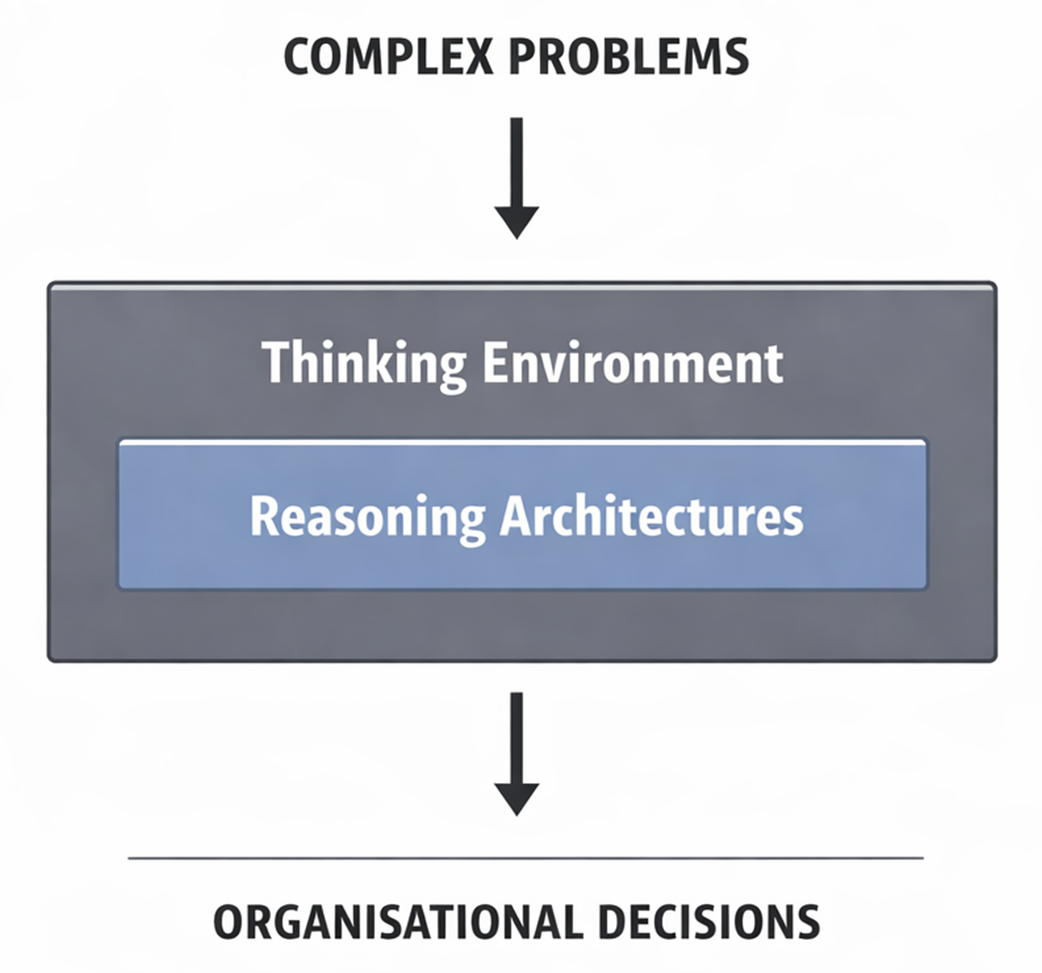
The nested-system diagram shows reasoning architecture operating inside an environment that can enable or constrain it at every step. section 1.2.3
A correct structure can still collapse
A group invited to explore alternatives quickly settles on one path as participants disengage under cognitive load. The structure is present, but the conditions do not sustain it. section 7.7
When a decision weakens, examine both whether the reasoning structure fits and whether the conditions let it work. The architecture may be sound while the environment neutralizes it. section 1.2.3 section 7.7