Third-party enrichment augments an organization’s first-party records with external data about who customers are, what they are, and what they seek. It turns a partial profile into a more useful customer view, much like adding context to an otherwise anonymous name. section 6.3.1 section 6.4
Enrichment can add information such as:
- Estimated household income, age range, marital status, credit behavior, home-buying likelihood, education, and renter or homeowner status. section 6.3.4
- Additional audience detail for more refined advertising, demographic segmentation, and personalized email creative. section 6.3.4
- Improved match rates and a more holistic customer view when enrichment is combined with identity resolution. section 6.4
Traditional enrichment sends first-party data to a provider for matching, or requires the organization to license a subset of external data and match it internally. Encryption and hashing improve security but do not remove the risk of transferring sensitive, valuable data. section 6.3.1
Data clean rooms reduce exposure by allowing parties to match records inside a shared environment without directly revealing information to one another. Cloud entity-resolution services can also perform matching within resources such as a marketing data lakehouse. section 6.3.1
A more relevant visitor profile
A retailer identifies an anonymous visitor as someone who usually buys sporting goods but is currently searching for women’s shoes. That context can support a timely Valentine’s Day promotion rather than an assumption that every visit reflects the customer’s usual category. section 6.3.4
Figure 6.9 Traditional third-party enrichment (sending/receiving data)
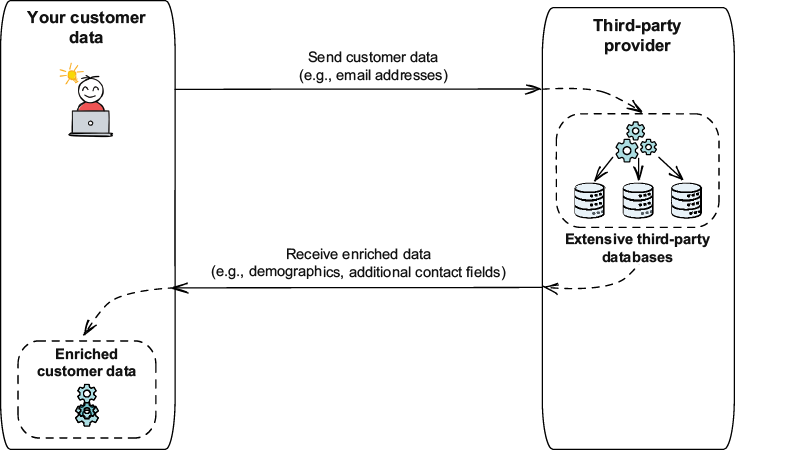
Shows the traditional send-and-receive flow used to exchange records with an enrichment provider. section 6.3.1
