A supplier is an external company engaged to provide software, products, or services. Organizations commonly use suppliers for capabilities that would be costly or distracting to maintain as an internal team, such as IT support, database management, cloud management, or security. The supplier typically provides staffing, training, continuity, and agreed response levels over a defined contract term. section 4.1.3 section 10.0
Evaluate a supplier against the needs and risks of the engagement, rather than choosing on price alone:
- Check that the supplier’s skills match the work immediately, and interview the people who will perform it. section 10.2
- Test depth of expertise with practical exercises, especially when the organization lacks the relevant capability internally. section 10.2
- Confirm accessibility, response times, communication practices, out-of-hours coverage, and seasonal support needs. section 10.2
- Assess scalability and continuity; avoid dependence on a single expert and verify that knowledge is shared across the supplier’s team. section 10.2
- Request comparable client references, relevant affiliations, pricing, and contract-tenure information. section 10.2
A commodity capability
A company might outsource employee desktops, printers, networks, databases, cloud management, or security when failure would seriously affect the business but maintaining a dedicated internal team would be distracting. A longer contract with explicit service-level agreements can provide coverage without carrying the full burden of hiring, training, and continuity. section 4.1.3
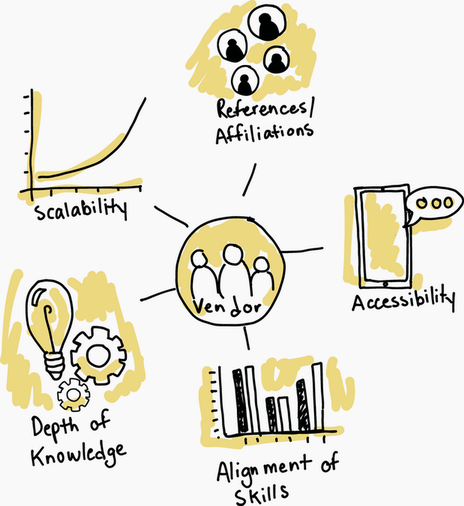
Use the vendor-evaluation figure to compare capability, accessibility, scalability, references, and other selection criteria before committing. section 10.2
Manage the relationship through a defined statement of work, service-level agreement, appropriate legal review, and accessible contract records. Also document intellectual-property assignment, confidentiality arrangements, licensing restrictions, support obligations, disaster recovery, and alternatives to dependence on one pivotal supplier. section 10.0 section 10.6 section 8.10

