A threat-hunting hypothesis is a testable proposition about possible malicious activity or compromise. It gives a proactive, human-led investigation a specific claim to investigate, evidence to seek, and findings to validate. section 3.2.1 section 1.4
Build and investigate a hypothesis through a repeatable hunt:
- Start with a triggering scenario, such as suspicious activity, a known intrusion pattern, or a control bypass. section 3.0
- State the suspected attacker behavior as a clear proposition, then define the affected environment and hunt scope. section 3.2.1
- Map the behavior to techniques, procedures, data sources, and observable events that could support or disprove it. section 3.2.1
- Search collected data for clues and evidence, pivot across findings, and construct an execution timeline. section 3.0 section 1.4
- Conclude the expedition by communicating results and relating activities to preparation, execution, and communication. section 3.0
Office document compromise
Hypothesis: an attacker spearphished users with a link to a malicious Word document; opening it executed code that compromised Windows endpoints. Investigators can search Sysmon events for Office spawning cmd, PowerShell, or a PowerShell script file, while mapping the activity to MITRE ATT&CK subtechniques T1566.002, T1059.003, and T1059.001. section 3.2.1
Figure 3.8 Threat-hunting process: Preparation phase
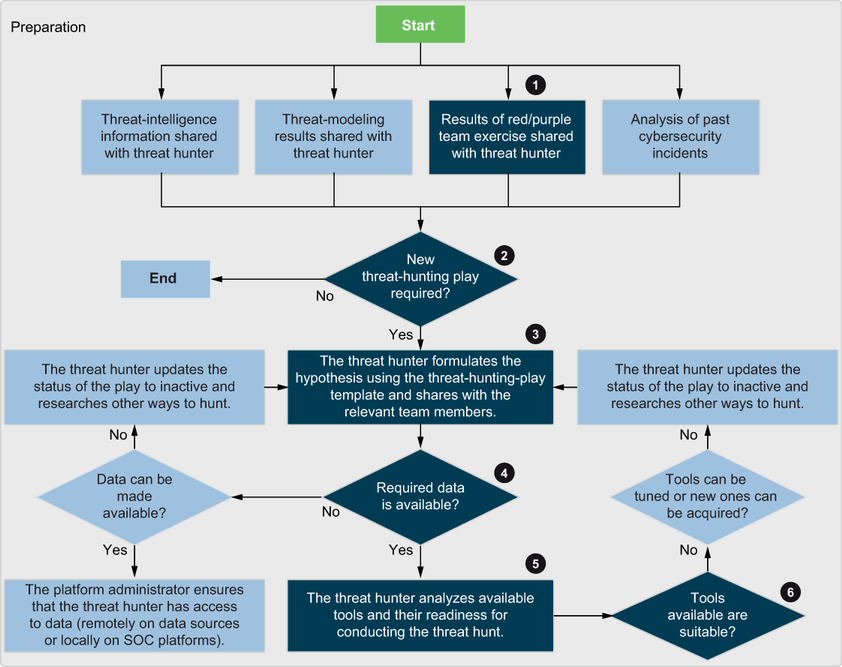
Use the preparation-phase diagram to connect the hypothesis with scope, techniques, procedures, and data sources before execution. section 3.2.1
