A time-series database (TSDB) stores and queries metric signals with time as the main index. Its bookkeeping unit is a metric composed of one or more time series, each tracking values over time. section 5.3
Core structure and query patterns include:
- Time is divided into buckets, potentially as fine-grained as seconds or milliseconds. section 5.3
- Each time series has a unique name and dimensions such as HTTP status code, URL path, or method. section 5.3
- Queries retrieve values or aggregates for matching series at an instant or across a time range. section 5.3
Service invocation counter
The series mysvc_http_request_total{status_code="400"} records HTTP API invocations returning status 400. As a counter, it increases monotonically; subtracting values across periods gives invocations during that period. section 5.3
Figure 5.2 Time series database concept, showing N time series of the mysvc_http_request_total metric
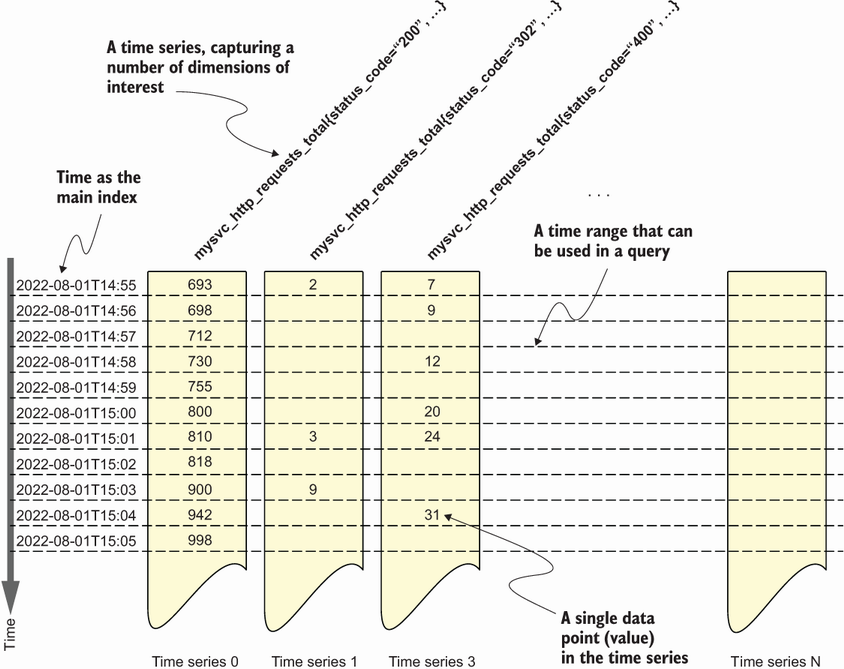
Use the figure to inspect how a metric expands into multiple time series indexed by time. section 5.3


