Time-to-market is the elapsed period from starting a product or feature to making it available to users. It is not merely a schedule target: it is an architectural force that narrows the set of designs a team can responsibly build, operate, and change. section 2.0 section 2.1
Short deadlines favor simplicity because complexity consumes coordination, integration, deployment, and operational attention. A design that is theoretically more flexible can be the riskier choice when its benefits depend on capabilities, boundaries, or needs that are not yet clear. section 2.1 section 2.7
Treat time-to-market as a decision constraint rather than a reason to suspend judgment:
- Make the delivery pressure visible alongside cost, team capability, ownership, and risk tolerance; no force acts alone. section 2.0 section 2.7
- Prefer choices that reduce moving parts when uncertainty is high and the team lacks mature operational practices. section 2.1
- Distinguish an explicit, reversible shortcut from unmanaged risk by recording why it was taken, who owns it, and when it will be reconsidered. section 2.1
- Revisit earlier choices as delivery pressure, organizational capability, and system needs change. section 2.0 section 2.7
Choosing a starting structure under pressure
A modular monolith can be a more responsible starting point than a distributed architecture when one team owns most of the system, domain boundaries are emerging, independent deployment is unnecessary, and operational maturity is limited. The choice preserves delivery capacity while leaving room to change once evidence clarifies the system’s needs. section 2.1
Figure 2.2 Time-to-market compresses the architectural option space. The less time available, the fewer classes of solutions remain realistic.
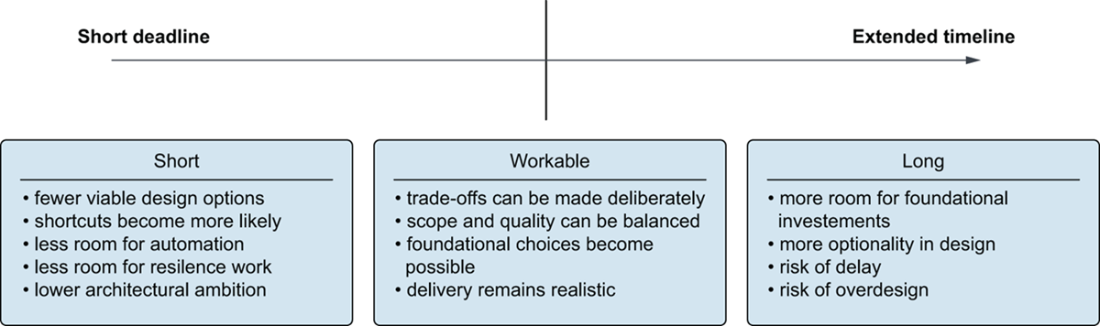
Time pressure compresses the architectural option space: fewer solution classes remain realistic as available time declines. section 2.1
The durable heuristic is to deliver the simplest structure that satisfies current needs without concealing consequential commitments. Speed is useful when its trade-offs are explicit, owned, and revisited; otherwise, apparent delivery acceleration becomes accumulated operational drag. section 2.1 section 2.7


