liveBook · Manning

Together, alone

As explained in Collaborative Software Design: How to facilitate domain modeling decisions

Together, Alone is a collaboration format in which participants work independently on the same task before comparing their results, combining individual and group work.

Together, alone is a collaborative modeling format: everyone works independently on the same problem, then shares and compares results before deciding what to do. Independent work lets each participant contribute knowledge without interruption or premature consensus. section 4.5.1

A practical session usually follows these steps:

  • Give everyone the same modeling problem and enough structure to begin. section 4.5.1
  • Let participants work silently for a defined period, such as roughly 20 minutes for architecture modeling. section 4.5.1
  • Have everyone share their model, then merge or build from the most complete model rather than the most accurate one. section 4.5.1
  • Record a legend explaining the model’s parts so absent participants can interpret it. section 4.5.1

EventStorming and 1-2-4-All

For EventStorming, participants first create their own event timeline before merging it. For a larger or harder problem, pairs can compare models, improve or merge them, and progressively combine into foursomes before sharing with the whole group. section 4.5.10 section 4.5.4

Figure 4.16 An example of using the together, alone style in a collaborative modeling Bytesize Architecture Session
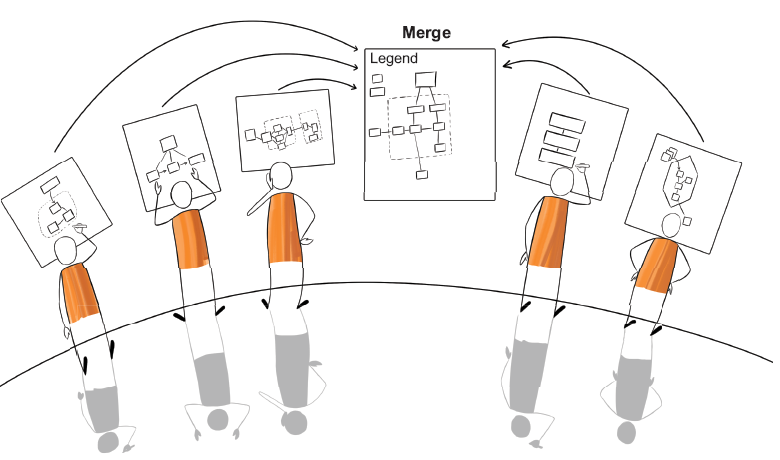
Use the architecture-session figure to see how independent models become one shared model. section 4.5.1

How Collaborative Software Design: How to facilitate domain modeling decisions covers it

How deep it goes
Explains the sequence, timing, heuristics, and scaling considerations, with examples from architecture modeling and EventStorming.
Examples
Uses Bytesize Architecture Sessions, EventStorming timelines, shared architecture models, and progressive pair-to-group merging.
What it assumes
Assumes a group facing the same modeling problem and teaches the individual-to-shared workflow from its basic steps.
What you can do after
Apply it via EventStorming or a Bytesize Architecture Session to elicit individual perspectives and construct a shared model.
How it connects
Connects design sprints, collaborative modeling, EventStorming, architecture modeling, and 1-2-4-All.

Related concepts

This explainer was generated by Manning's knowledge graph from the text of Collaborative Software Design: How to facilitate domain modeling decisions. The section links point to the parts of the book it draws on.