A shared mental model is a common understanding of a domain, situation, or system that a group builds together. In collaborative design, it matters more than the diagram alone: the model gives participants and stakeholders a basis for discussing business changes, solution strategies, and decisions. section 1.3.4 section 2.2.1
It is not created by declaring agreement. Participants arrive with different individual models, assumptions, and perspectives. Collaborative modeling brings those views into the open, challenges them, and works toward an unambiguous model and language within defined boundaries. section 4.3.4 section 2.2.1 section 8.2
Build a shared mental model through a facilitated cycle:
- Let people express their own understanding before group discussion, especially for a new problem or a group unfamiliar with collaborating in this way. section 4.5.1
- Share the individual models and merge them, using the most complete model as a foundation rather than treating one view as uniquely accurate. section 4.5.1
- Use sensemaking to surface perspectives, emotions, concerns, polarities, and potential conflicts that a visual model may not reveal. section 4.10 section 4.3.4
- Treat resistance and conflict as useful signals about group dynamics and missing input, rather than problems to suppress. section 8.2
- Record consequential decisions and their context, decision, and consequences, while keeping shared understanding—not documentation—as the primary result. section 1.3.4
Merging an architecture view
In a Bytesize Architecture Session, each team member models the architecture alone for about 20 minutes. The group then shares every valid view, selects one as a foundation, and merges the others into a shared architecture model. Add a legend so absent collaborators can interpret the result. section 4.5.1
Figure 4.10 Sensemaking exercise example using three options in a triangle. Using a pyramid offers several advantages: it captures nuanced opinions by providing a middle ground, reduces polarization by avoiding binary opposition, increases the accuracy of sensemaking collection by reflecting a wider range of perspectives, and enhances engagement by better matching individual views.
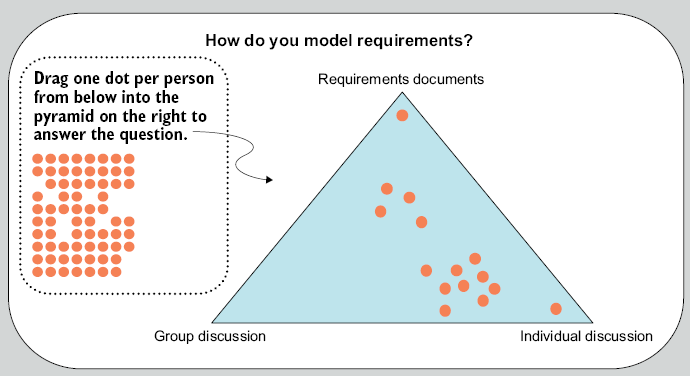
Use a three-option triangle when views are nuanced rather than binary. Dot placement makes the distribution of perspectives visible, opens discussion about the current and preferred future state, and can reduce polarization. section 4.3.4
A shared model does not require every person to attend or hold authority for every decision. Involvement still matters: it helps people support decisions and keeps the design adaptable as organizational needs evolve. Facilitation should balance enough structure to focus the work with enough openness for diverse insights to emerge. section 1.3.4 section 4.5.1
