A sustainability manager needs to assemble a report across compliance, HR, and finance teams. AI could help compose report sections, but the manager still has to guide the work and judge the result. That is augmentation: using technology to strengthen a person’s work rather than remove their involvement. The opportunity is more than saved writing time. Better accuracy and consistency could leave the manager more room for strategic planning and stakeholder engagement. section 10.1.1
Augmentation is one possible AI benefit, alongside automation and personalization. Start with a real user problem, not an AI feature looking for a purpose. An opportunity tree can help identify where improvement and augmentation might matter; prioritization then determines which opportunity to pursue. section 2.1.1 section 2.2
To choose a first task, assess each stage of the user journey:
- Value: How much effort does the task take, and what higher-value work does it displace? Consider improvements in accuracy and consistency as well as time saved. section 10.1.1
- Feasibility and desirability: Assess whether AI support is practical and whether users want it. Prioritize a small part of the journey for an MVP rather than attempting every stage at once. section 10.1.1
Figure 10.3 Look for automation potentials at the intersection of objective value, feasibility, and subjective desirability.
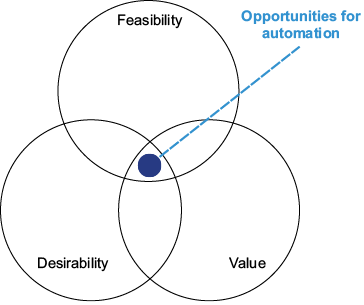
Use the value–feasibility–desirability intersection to compare candidate tasks before selecting one for AI support. section 10.1.1
The interface must preserve the user’s ability to assess AI contributions. Test prototypes with uncertain outputs and potential failures; show when AI is processing information, and let users modify or reject its output. After launch, collect feedback to find behavior and situations the team did not anticipate. This makes user control and calibrated trust part of the augmentation—not an afterthought. section 10.4

