liveBook · Manning

Topology

As explained in Geometry for Programmers

Topology is the study of properties of geometric objects that remain unchanged under continuous deformations.

Topology tracks properties that survive continuous deformation. In triangle modeling, it mainly means understanding which vertices, edges, and triangles touch one another. section 2.2.2

For triangle meshes, inspect these relationships:

  • A triangle can have up to three neighboring triangles. section 2.2.2
  • An edge normally borders at most two triangles; this supports a manifold triangle mesh. section 2.2.2
  • Degenerate triangles, including needles and caps, can disrupt the intended topology. section 2.2.2

A triangle’s neighborhood

Triangle ABC may touch ADB, BEC, and CFA. Edge AB has two adjacent triangles, while boundary edge AD has one; these relationships describe the mesh’s topology. section 2.2.2
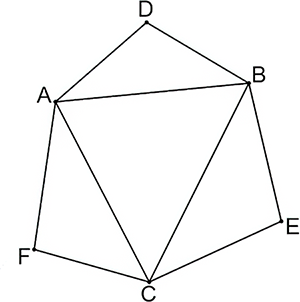
Figure 2.12 Triangle ABC and its three neighbors: FAC, CBE, and ADB
02-12

Use the neighborhood diagram to inspect how one triangle connects to its surrounding triangles. section 2.2.2

How Geometry for Programmers covers it

How deep it goes
Explains topology through triangle neighborhoods, edge counts, manifold meshes, and degeneracies without developing formal topology.
Examples
Uses triangle ABC, neighboring triangles, boundary edges, and degenerate needles and caps as concrete examples.
What you can do after
Diagnose mesh problems by checking triangle neighborhoods, edge adjacency, and degenerate triangles.
How it connects
Connects topology with triangle meshes, manifold meshes, nonmanifold meshes, edges, neighbors, and degenerate triangles.

Related concepts

This explainer was generated by Manning's knowledge graph from the text of Geometry for Programmers. The section links point to the parts of the book it draws on.