UMAP
UMAP, or Uniform Manifold Approximation and Projection, is a nonlinear manifold-learning technique that embeds high-dimensional data in a lower-dimensional space while preserving important neighborhood and structural relationships.
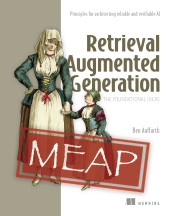
Retrieval Augmented Generation, The Foundational Ideas
UMAP (Uniform Manifold Approximation and Projection) is a nonlinear dimensionality-reduction technique that constructs a low-dimensional representation while preserving local and some global structure.
- How it is used
- Compresses text embeddings before clustering so recursive retrieval can preserve thematic organization instead of flattening documents.
- How deep it goes
- Explains graph construction, local/global preservation, parameter ranges, and a recursive-build guard, but omits mathematical proofs.
- Examples
- Uses 1536-dimensional text embeddings, 2–10 output dimensions, recursive document chunks, and adjustable neighborhood sizes as implementation examples.
- What you can do after
- Apply it via umap-learn to reduce embedding vectors and configure neighborhood size for local or broad thematic clustering.
Read how Retrieval Augmented Generation, The Foundational Ideas explains UMAP →

Build AI Drug Discovery Pipelines
Uniform manifold approximation and projection is a nonlinear dimensionality-reduction technique for embedding high-dimensional data in a lower-dimensional space.
- How it is used
- Uses nonlinear projections to inspect complex life-sciences datasets and support compound-screening workflows.
- How deep it goes
- Explains manifolds, contrasts UMAP with PCA on Swiss roll data, and demonstrates a tuned projection-classification pipeline.
- Examples
- Uses Swiss roll geometry and COVID Moonshot molecular fingerprints projected by activity and chemical series.
- What you can do after
- Apply it via umap-learn and scikit-learn pipelines, tuning neighborhood and separation parameters with cross-validation.

Machine Learning for Tabular Data: XGBoost, Deep Learning, and AI
UMAP is a nonlinear dimensionality-reduction technique based on manifold-learning principles that constructs a low-dimensional representation of high-dimensional data.
- How it is used
- Supports exploratory data analysis by projecting complex multivariate data into a few dimensions for visualization.
- How deep it goes
- Defines nonlinear projection, applications, and caveats, but does not explain UMAP’s algorithm or implementation.
- Examples
- Uses low-dimensional charts to inspect patterns, clusters, and isolated points that may indicate anomalies.
- What you can do after
- Evaluate/understand complex datasets by inspecting exploratory projections for visible patterns and clusters.
Read how Machine Learning for Tabular Data: XGBoost, Deep Learning, and AI explains UMAP →
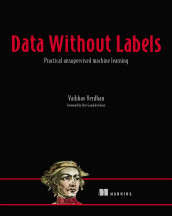
Data Without Labels
Uniform Manifold Approximation and Projection (UMAP) is a nonlinear manifold-learning technique for dimensionality reduction that constructs a low-dimensional embedding while preserving data relationships.
- How it is used
- Deploys nonlinear projection for visualizing high-dimensional data and preprocessing datasets before modeling.
- How deep it goes
- Explains manifold assumptions, graph construction, cross-entropy optimization, stochastic gradient descent, and two principal parameters.
- Examples
- Uses gene-expression data, language embeddings, and image datasets to illustrate visualization and similarity-based grouping.
- What you can do after
- Apply it via umap-learn to visualize data, reduce dimensions, and support clustering or anomaly-detection analysis.

Graph Neural Networks in Action
UMAP is a nonlinear dimensionality-reduction technique that projects high-dimensional data into a lower-dimensional space while attempting to preserve local and global structure.
- How it is used
- Uses UMAP to visualize high-dimensional Node2Vec graph embeddings and inspect clusters, patterns, and relationships.
- How deep it goes
- Explains projection goals and tuning parameters, then demonstrates Python usage; stops short of mathematical derivation.
- Examples
- Visualizes Political Books Node2Vec embeddings and compares UMAP with direct two-dimensional Node2Vec visualization and t-SNE.
- What you can do after
- Apply it via Python to project embeddings into two dimensions and plot interpretable graph-structure visualizations.
What to know first
- dimensionality reductionDimensionality reduction transforms data into a representation with fewer dimensions while attempting to retain relevant information or structure.
- Euclidean distanceEuclidean distance is the straight-line distance between two points, calculated as the square root of the sum of squared differences between corresponding coordinates.
- K-means clusteringK-means clustering is an algorithm that partitions data into a specified number of clusters by iteratively assigning observations to the nearest centroid and updating each centroid to the mean of its assigned observations.
- principal component analysisPrincipal component analysis is a linear statistical technique that represents data along orthogonal directions, called principal components, ordered by the variance they capture.
Related concepts
- dimensionality reductionkind of · Dimensionality reduction transforms data into a representation with fewer dimensions while attempting to retain relevant information or structure.
- manifold learningkind of · Manifold learning is a family of dimensionality-reduction methods that models high-dimensional data as lying on or near a lower-dimensional manifold.
- principal component analysisalternative to · Principal component analysis is a linear statistical technique that represents data along orthogonal directions, called principal components, ordered by the variance they capture.
Questions about UMAP
What is UMAP?
UMAP, or Uniform Manifold Approximation and Projection, is a nonlinear manifold-learning technique that embeds high-dimensional data in a lower-dimensional space while preserving important neighborhood and structural relationships.
Which Manning books explain UMAP?
Retrieval Augmented Generation, The Foundational Ideas, Build AI Drug Discovery Pipelines, Machine Learning for Tabular Data: XGBoost, Deep Learning, and AI, Data Without Labels and Graph Neural Networks in Action.
What should I know before learning UMAP?
Manning books that teach UMAP usually introduce dimensionality reduction, Euclidean distance, K-means clustering and principal component analysis first.
What is the difference between UMAP and principal component analysis?
UMAP, or Uniform Manifold Approximation and Projection, is a nonlinear manifold-learning technique that embeds high-dimensional data in a lower-dimensional space while preserving important neighborhood and structural relationships. Principal component analysis is a linear statistical technique that represents data along orthogonal directions, called principal components, ordered by the variance they capture.
What is UMAP a kind of?
UMAP is a kind of dimensionality reduction. Dimensionality reduction transforms data into a representation with fewer dimensions while attempting to retain relevant information or structure.
What is UMAP also called?
UMAP is also called Uniform Manifold Approximation and Projection.
These guides are generated from the text of Manning books by Manning's knowledge graph and link to the sections they draw on. The full books are available on liveBook and at manning.com.