UMAP is a nonlinear dimensionality-reduction technique for embedding high-dimensional data in a lower-dimensional space. It uses manifold learning to preserve meaningful local relationships when the data’s structure is nonlinear. section 7.1.4
The central contrast with PCA is structural:
- PCA assumes important patterns lie on a linear manifold, such as a plane or line. section 7.1.4
- UMAP can represent nonlinear geometry, such as unrolling the curved Swiss roll while retaining local relationships. section 7.1.4
- It calculates high-dimensional distances, converts them into similarity scores, and moves low-dimensional points closer or farther apart. section 7.1.4
COVID Moonshot compound screening
A Python pipeline applies UMAP with Jaccard distance and two components to molecular fingerprints, then feeds the projection into a five-neighbor classifier. Grid search tunes n_neighbors and min_dist using three-fold cross-validation and micro-averaged F1. section 7.1.4
Figure 7.6 UMAP develops an understanding of local relationships by calculating the distances between each pair of points in high-dimensional space, and using these as the basis for high-dimensional similarity scores that are used to move low-dimensional projects of the points closer or further from one another.
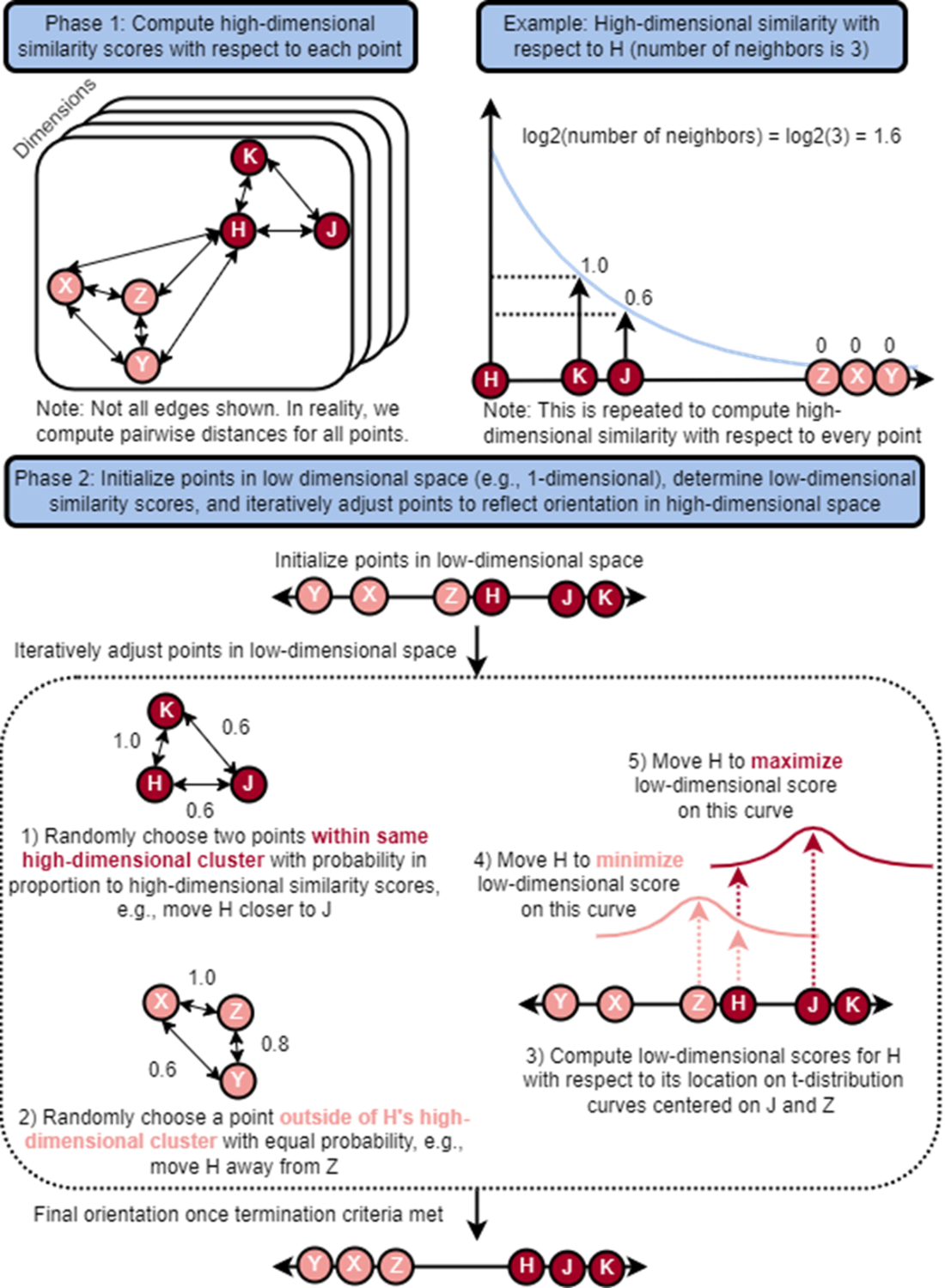
Shows how pairwise high-dimensional distances become similarity scores that guide the low-dimensional projection. section 7.1.4




