Tournament selection chooses individuals by randomly forming groups of size k and retaining the highest-fitness individual from each group. It turns local competition into a practical way to select candidates for reproduction or survival. section 7.3.3 section 7.3.5
A tournament-selection pass follows these steps:
- Randomly choose a group of k individuals from the current population. section 7.3.3
- Compare group members using their fitness values and identify the best performer. section 7.3.3
- Repeat the procedure m times when m individuals are needed for reproduction. section 7.3.3
- Apply genetic operators such as crossover and mutation to the selected winners. section 7.3.3
For survivor selection, tournament groups can draw from both the old population and newly generated offspring. Retaining the best member of each group can preserve diversity more effectively than simply keeping the best existing individuals. section 7.3.5
Ticket-pricing candidates
Use the ranked ticket-pricing candidates as a population. Randomly place several candidates into a tournament, compare their objective-function values, and advance the candidate with the highest value; repeat until enough winners are available for reproduction. section 7.3.3
Figure 7.12 Tournament selection
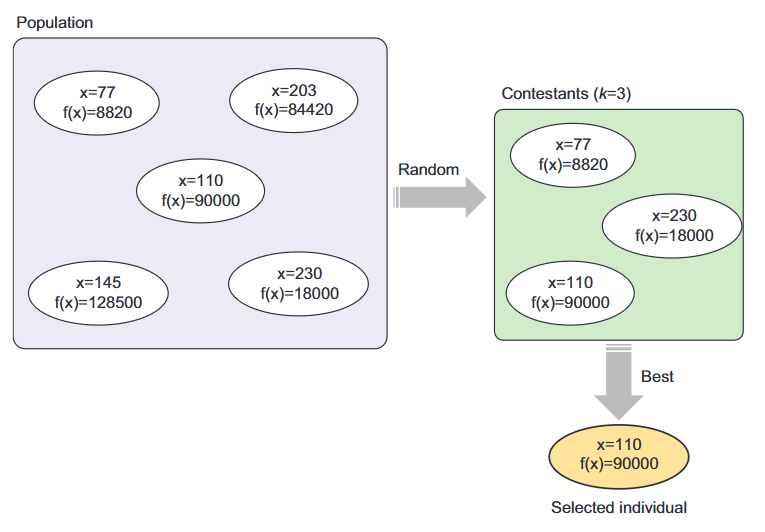
Use the tournament-selection figure to visualize random grouping, within-group competition, and winner advancement. section 7.3.3



