The traditional internal IT model, also called the zero-outsource model, is a deployment arrangement in which an organization purchases and manages an application’s infrastructure and software using internal resources. Internal IT staff install and operate the equipment, whether it supports office work or a specialized business application. section 3.1.1
A typical office setup includes an internet connection, router, firewalls, switches, servers, and desktop computers. An externally accessible application can use the same connection with a separate VLAN for isolation, or have dedicated connectivity and an isolated network. section 3.1.1
Internal IT is one option among several deployment models. With colocation, the organization still purchases hardware but uses a third-party facility for space, power, cooling, and connectivity. A managed service rents physical infrastructure, while a public cloud cost model can charge for resource consumption. section 3.1.1 section 3.1.2
Compare costs by separating capital expenditure (CAPEX), such as purchased hardware, from operating expenditure (OPEX), such as infrastructure operation and personnel. Existing capacity may make a new deployment’s incremental facility cost appear to be zero, but the equipment still consumes power and bandwidth, produces heat, and needs management. section 3.1.2
E-commerce infrastructure cost
An example deployment uses two firewalls, two load balancers, and six servers, costing $31,000 in total. Depreciated over three years, the hardware amounts to about $861 per month. This simplified calculation assumes existing power, cooling, rack space, and bandwidth have no additional incremental cost; it also excludes software costs and ancillary hardware. section 3.1.2
Figure 3.2. The total cumulative infrastructure cost for the example e-commerce application deployed in four different models. The internal IT model depicts a fixed initial cost due to capital equipment purchase and the implicit assumption that the organization is able to use existing operational resources allocated elsewhere, including the human resources to manage the infrastructure.
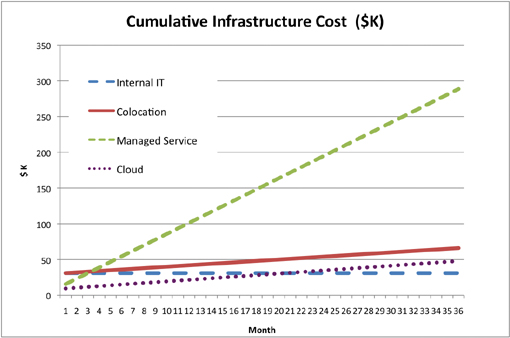
The cumulative-cost comparison shows why assumptions matter: internal IT has an initial equipment cost, while cloud spending accumulates over time. In this fixed-load example, cloud costs catch up after 18 months, assuming existing operational resources add no monthly cost to internal IT. section 3.2