A trailer is supplemental data added to the end of a transmitted message. At Layer 2, Ethernet adds a header and trailer around the packet to form a frame. The trailer helps detect transmission errors, such as those caused by electromagnetic interference. section 4.3.2 section 6.0
Key points:
- The Ethernet trailer contains one field: the Frame Check Sequence (FCS). section 6.2
- The Layer 2 header begins the message, while the trailer ends it and is the last part sent. section 4.3.2
- A switch uses Ethernet header information to make forwarding decisions; the trailer supports error checking rather than destination selection. section 6.2 section 6.0
Encapsulation sequence
A host prepares application data, adds Layer 4 and Layer 3 headers, then Layer 2 adds an Ethernet header and FCS trailer before transmitting the frame over a UTP cable. section 4.3.2
Figure 4.5 The five-step process of encapsulating and transmitting data: (1) the Application Layer protocol prepares some data, (2) Layer 4 encapsulates the data with a header, (3) Layer 3 encapsulates the data with a header, (4) Layer 2 encapsulates the data with a header and trailer, and (5) the host transmits the bits over the physical medium (i.e., a UTP cable).
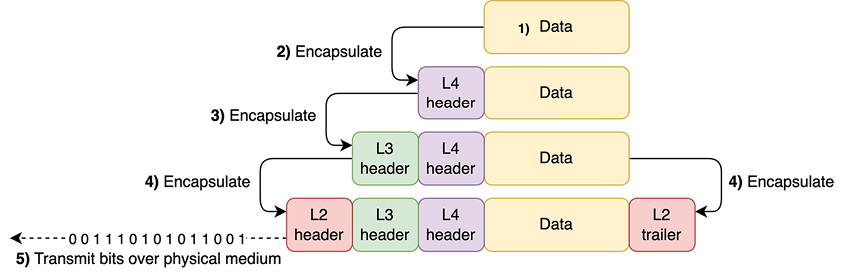
Follow the five-step diagram from application data through Layer 2 encapsulation and physical transmission. section 4.3.2
