A training algorithm is the procedure used to fit a machine learning model to data by optimizing its parameters or objective. It defines the model architecture and training plan, then runs as training code under a system that supplies CPU, GPU, memory, and—when needed—distributed computation. section 3.0 section 6.1.5
Select a training algorithm during research and prototyping by testing candidate approaches against available data and the product requirement. Accuracy alone is insufficient: compute needs, data volume, and implementation cost affect whether an approach is practical enough to adopt. section 1.1.1 section 10.1
Treat algorithm choice as part of an iterative production workflow:
- Explore data and identify approaches that can address the business requirement. section 1.1.1
- Build proof-of-concept models with multiple candidate algorithms and evaluate the resulting models. section 1.1.1
- Vet the selected data and algorithm with stakeholders before investing in production pipelines. section 1.1.1
- Stabilize training code and data shape, then onboard the chosen prototype into continuous training, deployment, evaluation, and serving pipelines. section 1.1.3 section 10.1
Customer-support intent matching
For a service that recognizes a customer question’s intent and matches relevant answers, prototype several deep learning models from collected training data. After evaluation, select one model, productionize its training code, and connect the deployed prediction service to the application backend under defined throughput and latency requirements. section 1.1.3
The same machine learning algorithm can appear in both training and serving, but it executes in different modes. Training produces model files; deployment copies those trained files into the production environment, where a prediction service loads them to handle requests. section 6.1.5
Figure 1.2 MLOps applies DevOps approaches to deep learning for the productionization phase, when models get shipped to production. (Source: Machine Learning Engineering in Action, by Ben Wilson, Manning, 2022, figure 2.7)
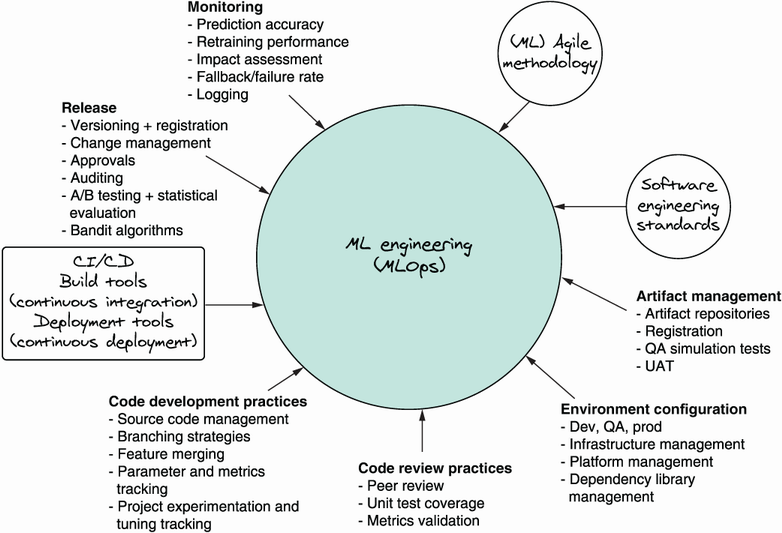
Use the productionization view to place training-algorithm work before MLOps practices that ship a model into production. section 1.1.1
For large datasets or model architectures, a training service becomes essential because it manages distributed execution and costly compute resources. Containerized training code can be launched and monitored through framework-specific Kubeflow operators, while Kubernetes APIs submit jobs and retrieve status or results. section 3.0 section 3.4.1
