A translation moves every point the same distance in the same direction. Although you may apply it to a square or another model, the transformation defines a rule for the whole space, such as ℝ² or ℝ³. section 2.4.2 section 4.1
Represent a two-dimensional translation with one displacement coefficient per axis:
- xₜ = xᵢ + dₓ and yₜ = yᵢ + dᵧ. The input coordinates are xᵢ and yᵢ; the translated coordinates are xₜ and yₜ. section 4.1.1
- Interpret dₓ as movement along the x-axis and dᵧ as movement along the y-axis. Substituting numbers produces a specific translation. section 4.1.1
- Apply the same displacement to every point of a model to translate the entire shape without changing the rule for space. section 9.1 section 2.4.2
A moving square
For a time-dependent translation, replace the fixed coefficients with functions: xₜ = xᵢ + sin(t) and yₜ = yᵢ + cos(t). Increasing t makes the square travel around its original center. This parametric transformation provides a direct geometric model for animation. section 4.1.1
Translation also has a vector interpretation: add the same vector to every point vector in a geometric model. Translation, rotation, scaling, and shear can later be generalized as projective transformations and represented through matrix multiplication. section 9.1 section 4.7
Figure 4.1 Three examples of standard square translations. A standard 1 × 1 square (transparent) moves and becomes the opaque square according to the coefficients.
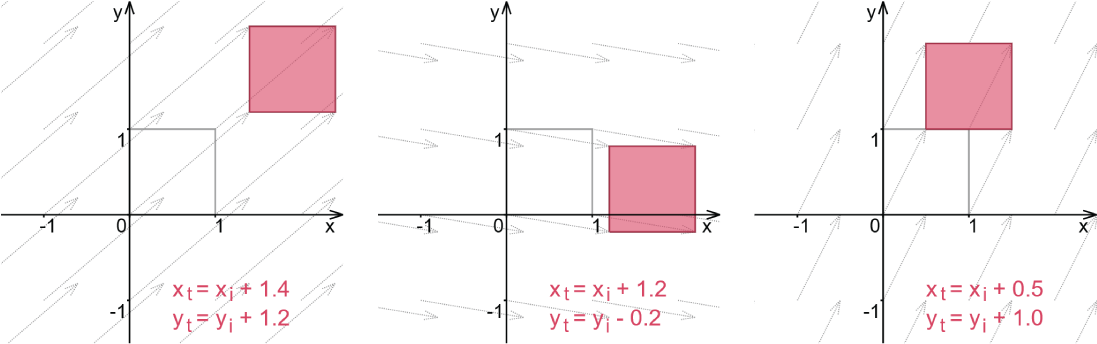
Compare three standard translations of a unit square and see how different displacement coefficients relocate the same shape. section 4.1.1
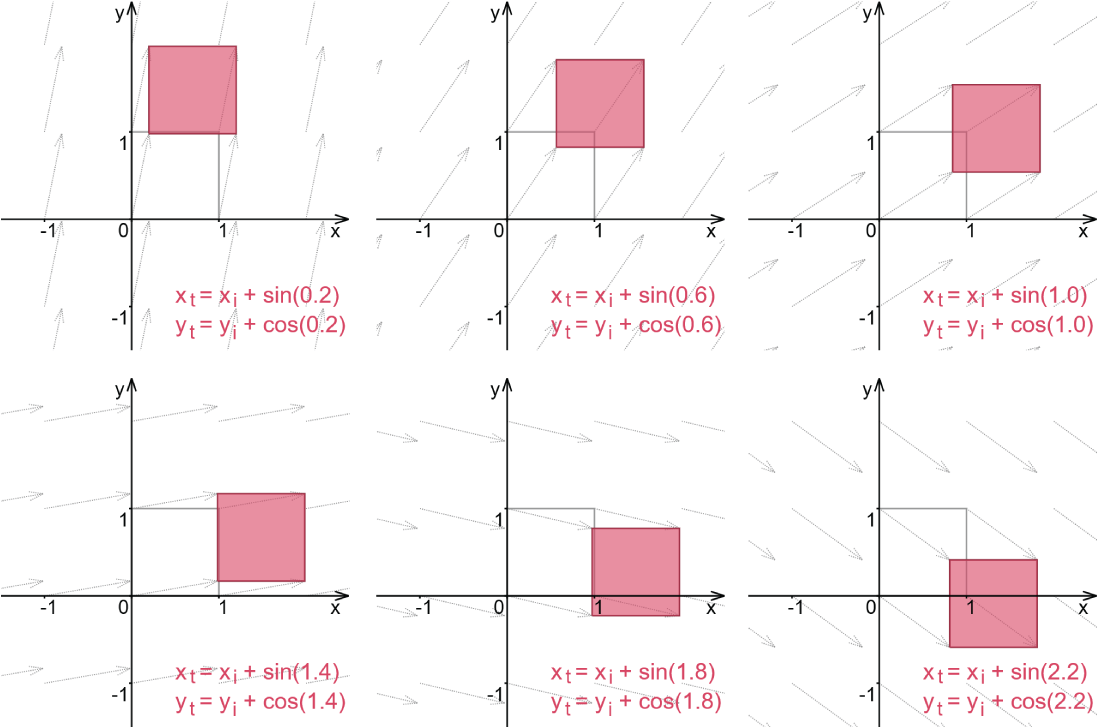
Observe how replacing fixed coefficients with sin(t) and cos(t) makes a square follow a circular path. section 4.1.1


