Translation invariance lets a learned pattern be recognized at different locations without relearning it. Convolutional networks achieve this by applying the same transformation to local patches across an input, producing a response map of pattern presence. section 8.1.1
A pattern moves across an image
Suppose a convolutional network learns an edge or small texture in the lower-right corner of an image. It can recognize the same pattern in the upper-left because the convolution scans equivalent local windows with shared transformations. A densely connected model would need to learn the pattern again at the new location. section 8.1.1
Use translation invariance as a practical modeling assumption:
- Choose convolution when the same local structure should retain similar meaning wherever it appears. section 8.1.1
- Expect the assumption to support data efficiency because one learned representation can generalize across locations. section 8.1.1
- Check the data before applying it to sequences: time-of-day effects or strong recency can make locations behave differently. section 13.2.4
Figure 8.3 The concept of a response map: a 2D map of the presence of a pattern at different locations in an input
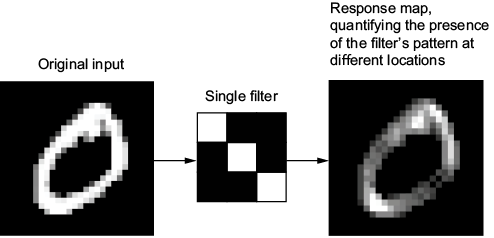
A response map makes the idea concrete by showing where a learned pattern appears across an input. section 8.1.1




