Translation invariance is the ability to recognize a pattern wherever it appears in an image. Convolutional layers support it by applying the same filter at every location, producing feature maps that show where the pattern responds. section 2.5.1
A visual pattern in different locations
A filter that responds to part of a cat’s face can detect that pattern at different image locations. In AlexNet’s first convolutional layer, 96 filters produce feature maps for deeper layers. section 2.5.1
Figure 2.3 The AlexNet architecture (cropped in the original paper). The numbers indicate spatial dimensions and channel depth at each stage. The input image (224 × 224 × 3 RGB) passes through a series of convolutional and pooling layers that progressively reduce spatial resolution (224→55→27→13) while increasing channel depth. Early downsampling is driven by the first convolutional layer (11 × 11 filters with a stride of 4), followed by max pooling layers (3 × 3 windows with a stride of 2) that further reduce spatial dimensions. The stride determines how far a filter moves across the input at each step, controlling how densely the image is sampled and how quickly spatial resolution is reduced. Filter sizes (11, 5, 3) are depicted as cubes and define the local receptive field of each convolution. The two horizontal streams reflect the model’s original two-GPU training setup, where feature maps were split across devices (e.g., 48 + 48 = 96 channels). The fully connected layers (4096 neurons, implemented as 2048 + 2048 across GPUs) feed into a 1000-way output for ImageNet classification. Used with permission granted by the lead author (Alex Krizhevsky).
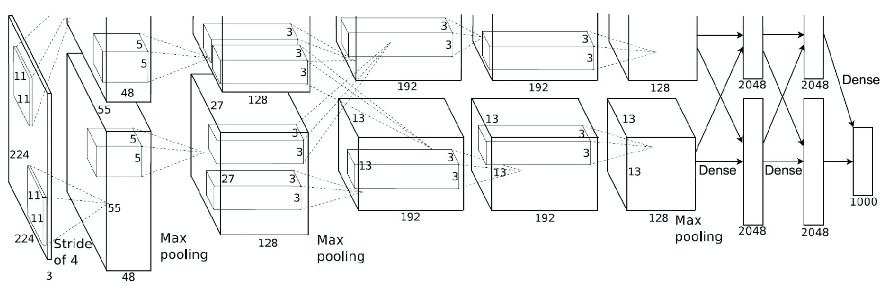
See how convolutional and pooling layers fit into AlexNet’s architecture and progressively reduce spatial resolution. section 2.5.1




