Tree-shaking is a build-time optimization that traces a program’s dependency tree and removes unused modules, exports, and sometimes code paths from the bundled application. section 6.5.1
ECMAScript Modules make this analysis practical because imports are static: they appear at the top level and cannot depend on variables, functions, or conditionals. Dynamic CommonJS loading is harder to analyze. section 6.5.1
Effective tree-shaking depends on how modules and functions are designed:
- Map imports and exports to identify unreachable modules and remove them from the packaged file. section 6.5.1
- Keep modules loosely coupled and internally cohesive so bundlers can analyze their dependencies more reliably. section 6.5.1
- Mark or recognize pure calls whose unused results have no side effects, allowing those calls to be removed as well. section 6.5.1
Unused exports and pure calls
An unused export such as `foo` can disappear from the bundle. A pure call such as `/*#__PURE__*/checkTampering(...)` can also be removed when its result is unused. section 6.5.1
Figure 6.2 Bundler tools can use the static structure of your application to achieve tree-shaking by identifying any unused modules of code and removing them from the packaged application file.
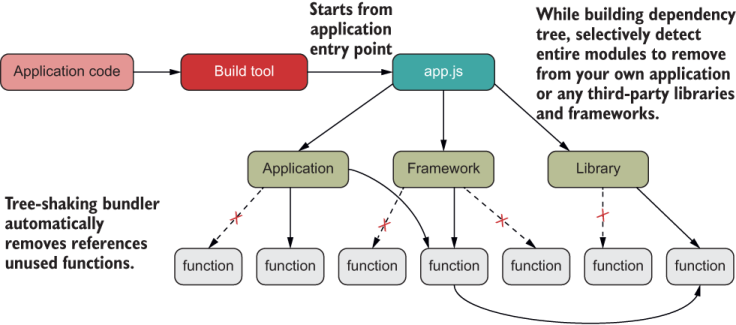
Trace how a bundler uses the application’s static structure to locate unused modules and remove them from the packaged application. section 6.5.1

