liveBook · Manning

Tree-shaking

As explained in Web Components in Action

Tree shaking is static analysis that removes imported code and other module parts that are not used from a bundle.

Tree shaking analyzes module imports and excludes imported code that the application never uses, producing smaller JavaScript bundles with only the required code. section 12.4

Unused modules in a component bundle

Suppose a component imports a module but never calls or references it. A bundler such as Rollup can omit that module from the final output. For a larger application, separate functionality bundles can also keep account information code out of a user’s transaction view. section 12.4
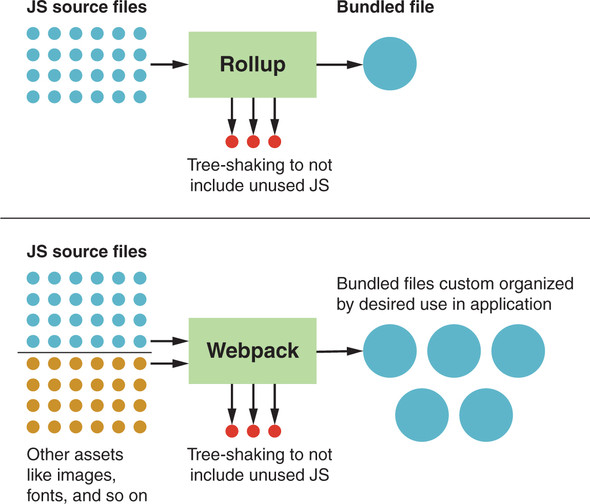
Figure 12.1. Rollup vs. Webpack

Compare Rollup’s simpler bundling approach with Webpack’s more complex support for multiple output bundles and additional file types. section 12.4


How Web Components in Action covers it

How deep it goes
Defines import tracking and omission, then stops short of explaining the analysis algorithm or configuration details.
Examples
Uses an unused module and a banking application separating transaction and account-information bundles.
What it assumes
Introduces the shift from pre-ES2015 file concatenation to module-based imports and bundling.
What you can do after
Apply it via Rollup or Webpack to create smaller bundles containing only needed module code.
How it connects
Connects ES modules, import statements, module bundling, build processes, and multiple output bundles.

Also explained in

Compare how 2 books explain tree-shaking →

Related concepts

This explainer was generated by Manning's knowledge graph from the text of Web Components in Action. The section links point to the parts of the book it draws on.