A trial deployment releases a system in a limited way before committing to broad adoption. It reveals whether the system helps, harms users, or creates costs that a simple process diagram hides. section 8.1
A careful trial deployment can:
- Run the new system alongside the existing process for weeks or months while people continue using the established workflow. section 8.1
- Compare outputs, identify discrepancies, address problems, and check whether performance degrades over time. section 8.1
- Evaluate business effects such as customer retention before replacing human or outsourced support. section 8.1
Customer-support chatbot
A company can run an LLM chatbot beside its existing FAQs, email tickets, and support numbers, ignoring the chatbot's decisions at first. Comparing its answers with the established process can expose incorrect policy statements, liability, and hidden remediation work. section 8.1
Figure 8.1 When looking at the process diagram, it would seem like replacing FAQs, email tickets, and support numbers could be simplified and streamlined with an LLM-based chatbot. However, the folly of this view is that the process is incomplete. The potential errors and remediation processes required to ensure an LLM will perform accurately are hidden and create more complexity.
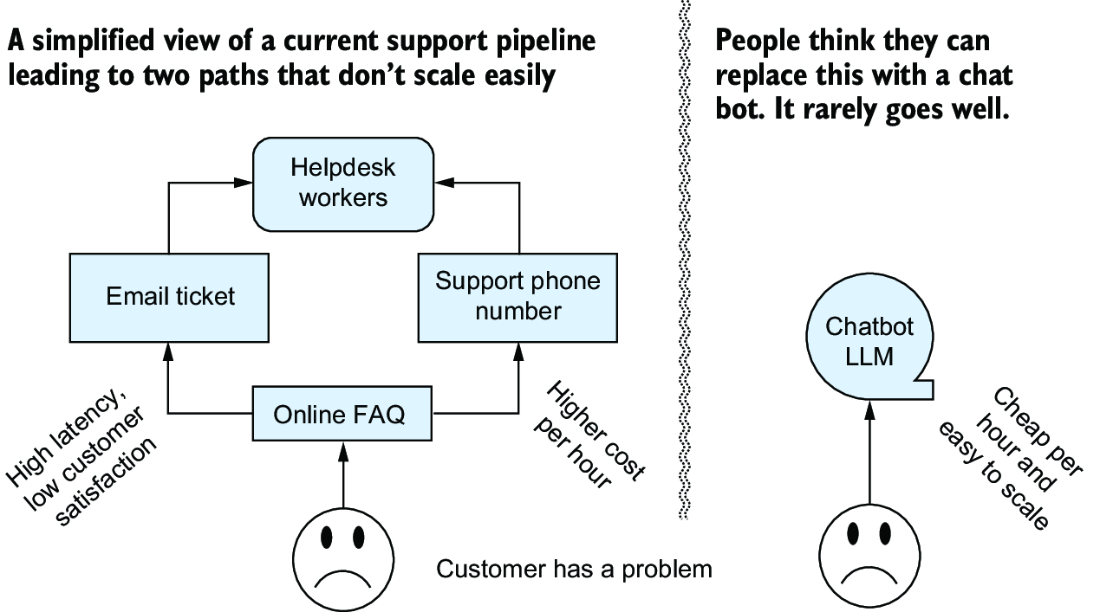
The process diagram highlights how apparent chatbot simplification can conceal error handling and remediation work. section 8.1
