Tacit knowledge becomes a production risk when speed exposes an asymmetry: types, tests, and contracts are cheap to generate, while deciding whether software matches business intent still requires human judgment. AI handles scaffolding and common patterns; edge cases, integration, security, performance, and verification remain the difficult work. section 1.8
In an engineering organization, tacit knowledge includes the conventions, ownership rules, historical decisions, operational habits, and reasons that source code does not record. Context systems make this knowledge explicit through architecture, code conventions, organizational policies, ADRs, incidents, and telemetry. section 3.5.3
Convert tacit knowledge into artifacts that agents and engineers can query:
- Document informal conventions and approval expectations instead of relying on shared memory. section 5.5
- Record architecture, ownership, service relationships, historical rationale, incidents, and operational signals in loadable context. section 3.5.3
- Expose dependencies, package status, supported tasks, and affected consumers through machine-readable build metadata. section 10.2.2
- Validate changes across the computed blast radius rather than testing only the edited package. section 10.2.2
Replacing tribal memory with graph queries
Before changing shared-utils, an agent queries reverse dependencies, tests every affected consumer, investigates failures, and lists those consumers in the pull request. Production and deprecated package tags prevent guessing from filenames or modifying the wrong package. section 10.2.2
Figure 3.11 The context pyramid: five interdependent layers of the Context Fabric. Each layer rests on the ones below it - a gap low in the pyramid undermines everything above, no matter how complete the upper layers are.
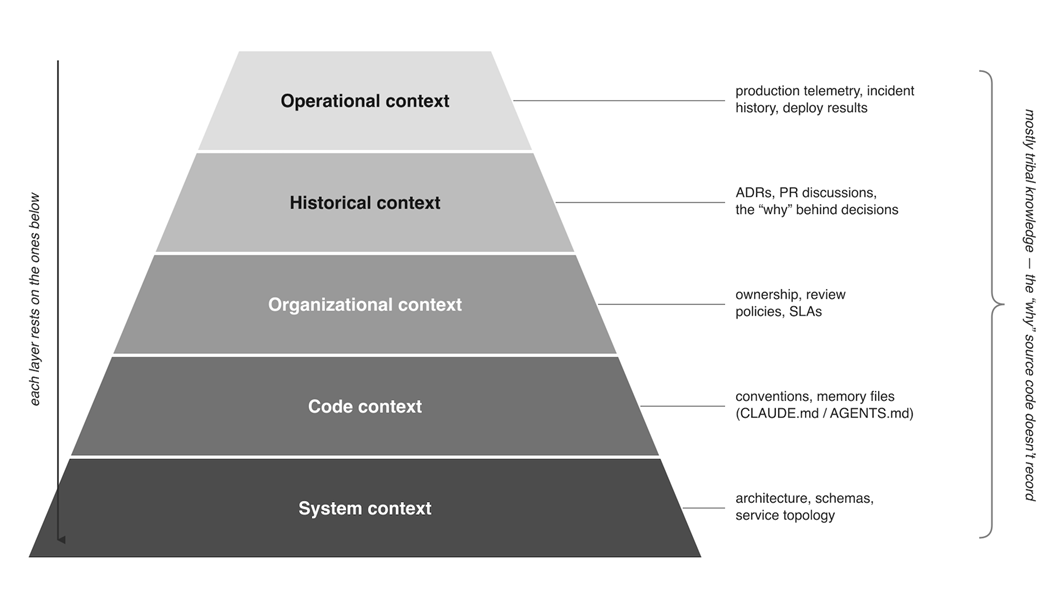
The context pyramid shows how system, code, organizational, historical, and operational knowledge depend on one another; missing lower layers can invalidate higher-level guidance. section 3.5.3

