Trunk-based development keeps the main branch continuously releasable. Developers use short-lived feature branches, validate changes before merging, and avoid introducing changes that break the main branch’s build or release process. section 3.3
A trunk-based workflow connects branch validation to release automation:
- Run a pipeline for each feature branch or pull request to verify that the changes build, test, and can be released against the main branch. section 3.4.1
- Run the service pipeline after changes merge to main, producing artifacts from the latest code base. section 3.4.1
- Treat a failing main-branch pipeline as an urgent problem; teams should focus on restoring the releasable state instead of merging more breakage. section 3.4.1
- Create a Git tag for a release so the resulting artifact can be traced to the specific main-branch commit that produced it. section 3.4.1 section 3.4
A merge-to-release flow
A developer completes and tests a feature on a feature branch, opens a pull request, and waits for its validation pipeline. After review and a successful check, the change merges into main. The main-branch pipeline builds and tests the service, publishes binary artifacts, builds the container image, and can produce a tagged release. Each successful merge therefore supplies a tested, traceable release candidate. section 3.4.1 section 3.4
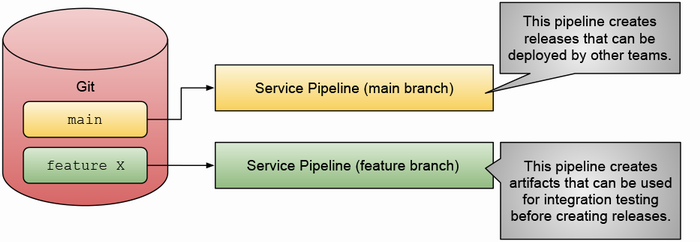
Use the pipeline diagram to compare validation on feature branches with release-producing execution on the main branch. section 3.4.1



