A supply chain manager sees a predicted-demand chart. Should they act on the forecast, or question it? Trust calibration helps users find a useful middle ground: relying on an AI product for the value it provides while staying alert to mistakes. Too little trust can prevent adoption; too much can lead to harmful decisions. section 10.2.2 section 12.1.4
Start with users rather than assuming everyone needs the same warning. Interviews and surveys can reveal their AI literacy, confidence in the task, reactions to errors, concerns about AI, and desired level of control. A confident user may be less disciplined about checking an answer; another may distrust the system after a bad experience. section 10.1.2
Design cues should help users decide when to rely on an output and when to inspect it:
- State limitations plainly. An up-front alert can encourage verification; a specific caveat can say that reports cover European markets but not yet other regions. section 10.2.2
- Make uncertainty visible where decisions happen. A confidence indicator can flag an output that needs more work. section 10.2.2
- Give users ways to inspect or intervene. Showing original sources can aid scrutiny, while a stop control lets users halt a generation that has gone off track. section 10.2.2
A forecast that shows its uncertainty
For a predicted-demand chart, a shaded confidence interval around the prediction line can answer a supply chain manager’s question: how sure is this forecast? The design discussion stays focused on that decision, not on making the dashboard look more futuristic. section 12.1.4
Figure 10.19 On the trust continuum, aim for calibrated trust.
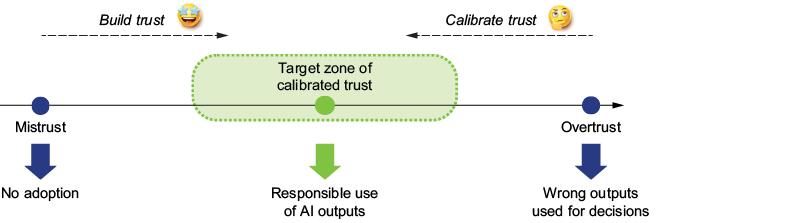
The trust continuum illustrates the aim: neither rejection of the AI nor uncritical reliance, but calibrated trust. section 10.2.2
Trust cues work best when product and UX decisions begin with a concrete user question. Designers can then choose wording, visual uncertainty cues, or controls that fit both the task and the AI’s limitations. section 12.1.4 section 10.1.2
