A trusted execution environment (TEE), also called an enclave, is a hardware-backed area where code and data remain protected while they are being processed. Unlike ordinary memory, which may expose clear-text data to anyone inspecting RAM, a TEE encrypts memory access on the fly. section 9.2.1
Confidential computing uses TEEs to protect data in use, complementing protections for data at rest and data in transit. CPU support includes Intel SGX, AMD SEV, ARM TrustZone and CCA, and RISC-V Keystone. section 9.2.1
Training an AI model on private hospital data
A hospital can keep patient records confidential while an institution protects its proprietary model. Both are loaded into an enclave on an untrusted server, where the computation runs without exposing either input to the hosting environment. section 9.2.1
Wasm fits TEE deployments when the environment benefits from:
- A minimal runtime and language-agnostic execution model that help keep the trusted computing base small. section 9.5
- Sandboxed execution for multiple tenants running securely side by side. section 9.5
Figure 9.2 The three states of data: at rest, in transit, and in use. Each state represents a potential point of vulnerability where data can be exposed or compromised if not properly protected.
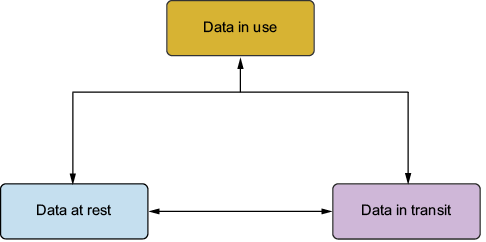
Use the three data states to locate the TEE’s role: it addresses exposure while data is actively being processed in memory. section 9.2.1


