liveBook · Manning

Decisive core

As explained in Architecture Modernization: Socio-technical alignment of software, strategy, and structure

A decisive core is a core-domain-chart pattern describing a strategically important subdomain that warrants substantial investment in people, collaboration, and architecture.

A decisive core is a strategically important subdomain that combines high differentiation with high complexity. Success can create a decisive market advantage because an effective solution is difficult to develop and copy. section 10.3.1

Treat a decisive core as a long-term investment:

  • Build it in-house to retain control over a highly strategic capability. section 10.3.1
  • Staff a dedicated team with a majority of senior, highly skilled people. section 10.3.1
  • Increase collaboration among engineers, product, UX, and subject matter experts during discovery and development. section 10.3.1
  • Use EventStorming and related collaborative practices to improve innovation and change flow. section 10.3.1
  • Prioritize dependency management, architecture, domain modeling, and code health; advanced architectural patterns may be justified. section 10.3.1

Market advantage

A subdomain that enables an organization to become a market leader—or catch up with an established leader—can warrant decisive-core treatment when its solution is both highly differentiating and difficult to develop or copy. section 10.3.1
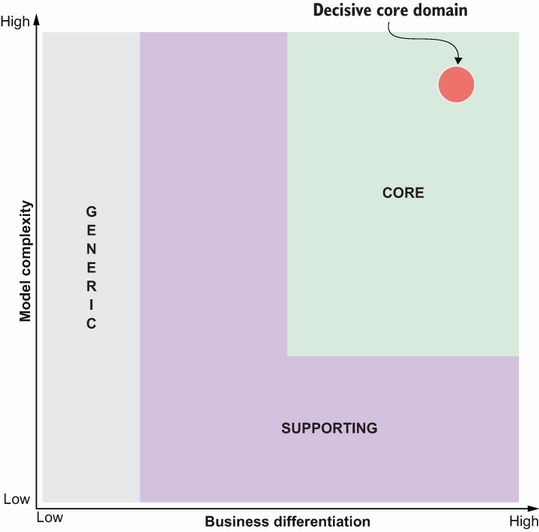
Figure 10.9 The decisive core pattern

Use the decisive-core pattern on a Core Domain Chart to identify subdomains requiring exceptional strategic and technical investment. section 10.3.1

How Architecture Modernization: Socio-technical alignment of software, strategy, and structure covers it

How deep it goes
Explains strategic, organizational, and architectural treatment, but stops short of prescribing a specific implementation.
Examples
Uses market leadership or catching up with an established leader to illustrate decisive strategic advantage.
What it assumes
Assumes the ability to assess subdomains by differentiation and complexity on a Core Domain Chart.
What you can do after
Evaluate subdomains and prioritize in-house talent, collaboration, architecture, and dependencies where strategic returns are highest.
How it connects
Connects Core Domain Charts with differentiation, complexity, EventStorming, domain modeling, architecture, and Wardley Mapping.

Related concepts

This explainer was generated by Manning's knowledge graph from the text of Architecture Modernization: Socio-technical alignment of software, strategy, and structure. The section links point to the parts of the book it draws on.