Twisted pair is a cable construction in which conductors are helically twisted into pairs, reducing electromagnetic interference (EMI) between wires. A copper unshielded twisted-pair (UTP) cable contains eight wires arranged as four pairs. UTP has no metallic shield, unlike shielded twisted pair (STP). section 3.3
Figure 3.2 Two 8P8C ports on a Cisco switch (left) and an 8P8C connector on a copper UTP network cable (right)
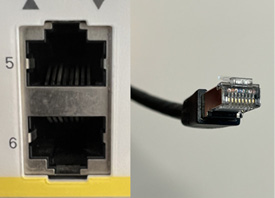
An 8P8C connector, commonly called RJ45, has eight pins—one for each wire—and plugs into compatible switch or device ports. section 3.3
Use the cable’s pairs, category, and distance limits to match it to the Ethernet connection:
- 10BASE-T and 100BASE-T use two pairs; 1000BASE-T and 10GBASE-T use all four pairs. section 3.5
- Common pairings are Cat 3 with 10BASE-T, Cat 5 with 100BASE-T, Cat 5e with 1000BASE-T, and Cat 6a with 10GBASE-T. section 3.3.1
- Copper UTP connections support up to 100 meters; longer runs can attenuate signals and reduce performance. section 3.3.1
- Choose UTP commonly for end-host-to-switch links because it costs less; consider fiber for longer, infrastructure-to-infrastructure links or high-EMI environments. section 3.4.2
