liveBook · Manning

Type 5 lsa

As explained in Acing the CCNA Exam: Volume 1 Fundamentals and Protocols

A Type 5 LSA is an OSPF autonomous-system-external advertisement generated by an autonomous system boundary router to advertise routes to external networks.

A Type 5 LSA, or AS External LSA, is generated by an OSPF autonomous system boundary router (ASBR) to advertise routes to networks outside the OSPF autonomous system. A common example is a default route to the internet. section 18.4

Remember these exam-relevant points:

  • ASBRs generate Type 5 LSAs. section 18.5
  • The LSA is distributed through the OSPF link-state database (LSDB). section 18.4
  • Use show ip ospf database to view Type-5 AS External Link States. section 18.4

Default route to the internet

In an OSPF network connected to the internet, R1 acts as the ASBR and advertises a default route with default-information originate. The LSDB on the routers then shows R1 advertising a Type 5 LSA for 0.0.0.0. section 18.4

Figure 18.14 An OSPF AS and the contents of its LSDB. Each router advertises a type 1 (Router) LSA. R5, as the DR of the R2–R3–R4–R5 segment, advertises a type 2 (Network) LSA. R1, as an ASBR, advertises a type 5 LSA.
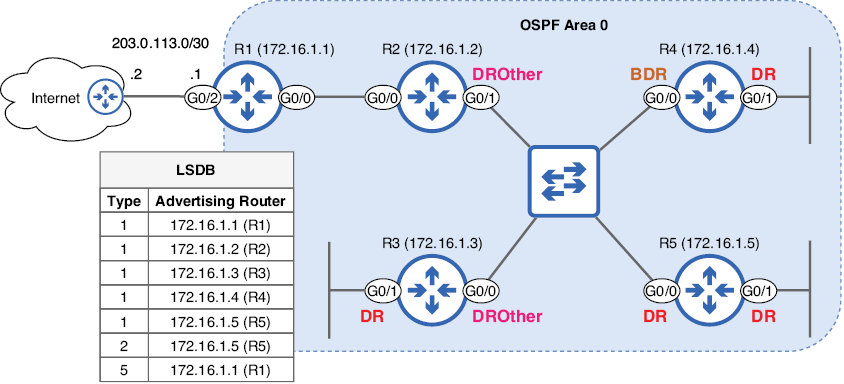
Use the topology and LSDB diagram to connect the ASBR, the external connection, and the resulting Type 5 LSA. section 18.4

How Acing the CCNA Exam: Volume 1 Fundamentals and Protocols covers it

How deep it goes
Defines generation and LSDB visibility but defers detailed interpretation of command output beyond CCNA scope.
Examples
Uses R1 advertising 0.0.0.0 toward the internet and displays the result with show ip ospf database.
What it assumes
Assumes basic OSPF and routing knowledge while defining ASBRs, LSAs, and LSDBs in context.
What you can do after
Diagnose external-route advertisements by identifying the ASBR and inspecting Type-5 entries in the OSPF LSDB.
How it connects
Connects OSPF with ASBRs, LSUs, LSAs, LSDBs, default routes, and Type 1 and Type 2 LSAs.

Related concepts

This explainer was generated by Manning's knowledge graph from the text of Acing the CCNA Exam: Volume 1 Fundamentals and Protocols. The section links point to the parts of the book it draws on.