A link-state advertisement (LSA) is an OSPF data structure that describes a router’s links and connected networks. Routers flood LSAs through an OSPF area, where they are organized into a link-state database (LSDB). The LSDB gives each router a shared topology map for calculating shortest paths with the SPF algorithm. section 18.1.1 section 18.5
Remember these practical points:
- LSUs carry LSAs; think of the LSU as the envelope and the LSA as the routing information inside it. section 18.3.1
- LSA flooding distributes an LSA to routers throughout the same OSPF area so their LSDBs remain synchronized. section 18.1.1 section 18.5
- Type 1 Router LSAs describe router links, Type 2 Network LSAs list routers on a broadcast segment, and Type 5 AS External LSAs advertise external routes. section 18.4
- Larger areas create larger LSDBs and increase memory and SPF-processing demands; multiple areas limit changes and advertisements to local areas. section 18.1.2
Reading an OSPF topology
If R1 connects to 10.0.0.0/30, 10.0.0.4/30, and 10.1.1.0/24, its Router LSA can describe those networks and their costs. On a broadcast segment, the designated router can add a Network LSA; an ASBR can add a Type 5 LSA for a default route. Verify the shared database with show ip ospf database. section 18.4
Figure 18.1 Routers flood LSAs within the OSPF area to ensure all routers have an identical LSDB. The LSAs that make up the LSDB contain information about each router’s connected networks, such as their cost. R1’s LSA indicates that it is connected to 10.0.0.0/30, 10.0.0.4/30, and 10.1.1.0/24, each with a cost of 1.
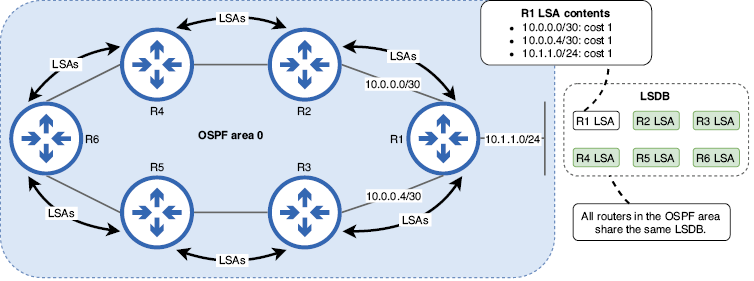
Use the topology figure to trace how one router’s LSA describes connected networks and how flooding builds an identical LSDB on neighboring routers. section 18.1.1
