liveBook · Manning

Type state

As explained in Embedded Software with Rust

The typestate pattern represents an object's state in its type so that operations can be restricted to valid states at compile time.

Type state encodes a peripheral’s configuration in its Rust type. A HAL can then expose only the operations valid for that state, making some hardware misuse a compile-time error. section 1.4.3

In GPIO and clock setup, type state makes configuration transitions explicit:

  • Converting a pin consumes it and creates a new type for its configured mode, so input-only and output-only operations are restricted accordingly. section 5.3.4
  • Constrain and freeze move clock peripherals into managed states; the resulting Clocks value can configure timing-dependent peripherals and SysTick delays. section 5.3.4

UART receive pin

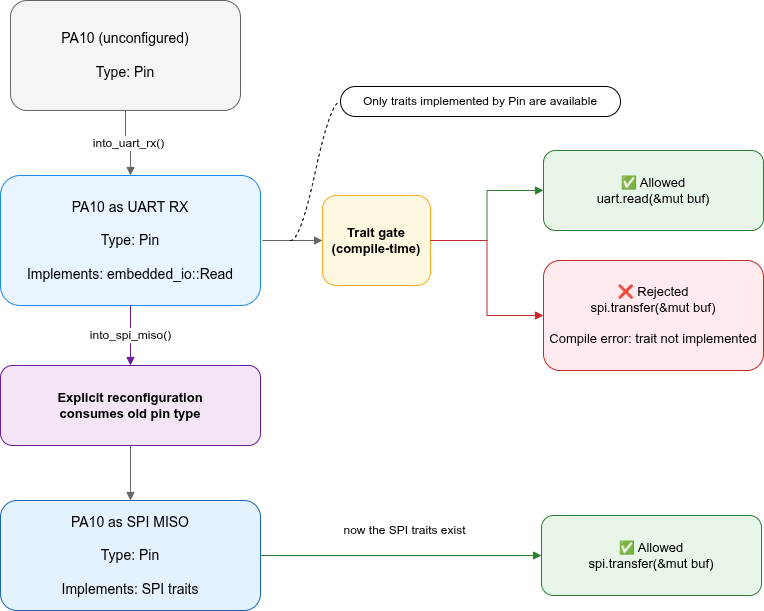
A pin configured for UART reception can implement receiving traits such as Read. Attempting to use it for an SPI-specific operation fails to compile; changing its function requires explicit reconfiguration. section 1.4.3

Figure 1.4 Type state pattern applied to MCU pins
CH01 F04 Cabanis

Illustrates type state applied to microcontroller pins. section 1.4.3

How Embedded Software with Rust covers it

How deep it goes
Explains type-level modes, trait-limited operations, ownership-based pin conversion, and validated clock states.
Examples
Demonstrates UART receive versus SPI misuse, GPIO pin-mode conversion, and frozen clocks for SysTick delays.
What you can do after
Apply it through a HAL to configure pins and clocks while catching invalid operations at compile time.
How it connects
Connects hardware abstraction layers, GPIO, UART, SPI, traits, ownership, and clock configuration.

Also explained in

Compare how 3 books explain type state →

Related concepts

This explainer was generated by Manning's knowledge graph from the text of Embedded Software with Rust. The section links point to the parts of the book it draws on.

