UDP is a connectionless transport-layer protocol. DHCP uses UDP at Layer 4 while exchanging messages to lease an IP address, without TCP’s reliability or ordering guarantees. section 4.1.1
DHCP assigns fixed UDP ports to both sides of the exchange:
- UDP 67 identifies the DHCP server, which sources messages from and listens on this port. section 4.1.1
- UDP 68 identifies the DHCP client, which sources messages from and listens on this port. section 4.1.1
UDP in the DHCP DORA exchange
A client broadcasts DISCOVER, receives an OFFER, sends REQUEST, and receives ACK. The exchange uses UDP ports 68 for the client and 67 for the server. section 4.1.1
Figure 4.2 Leasing an IPv4 address via DHCP (the DORA process): (1) DISCOVER from client to server, (2) OFFER from server to client, (3) REQUEST from client to server, (4) ACK from server to client.
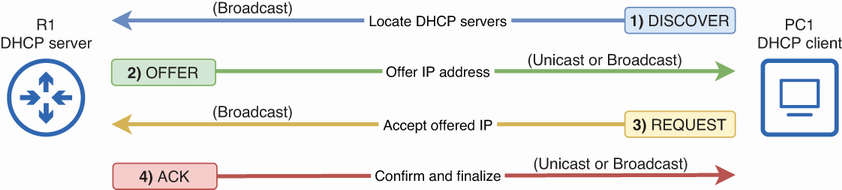
Trace the four-message DHCP exchange and identify where UDP carries each client-server message. section 4.1.1




