liveBook · Manning

UML sequence diagram

As explained in Object-Oriented Software Design in C++

A UML sequence diagram is a UML diagram that represents interactions between participants in time order.

A UML sequence diagram represents runtime interactions among objects in time order. Time proceeds from top to bottom, while lifelines show participants and horizontal arrows show calls to member functions. section 4.6

Use it to check whether member functions and class relationships support a use case. The diagram can document a design at either a high or low level of detail. section 4.6 section 4.8

Book catalogue search

A customer fills target attributes in a Form and presses Submit. The Form notifies the Catalogue, which searches Book objects; Books match Attributes objects, and the Catalogue displays the matching books. section 4.6

Figure 4.16 A UML sequence diagram for a customer searching for books that match target book attributes. At a high level, it shows the runtime interactions among objects involved in this use case as time goes from top to bottom. Such a diagram helps to ensure that we designed the class relationships correctly.
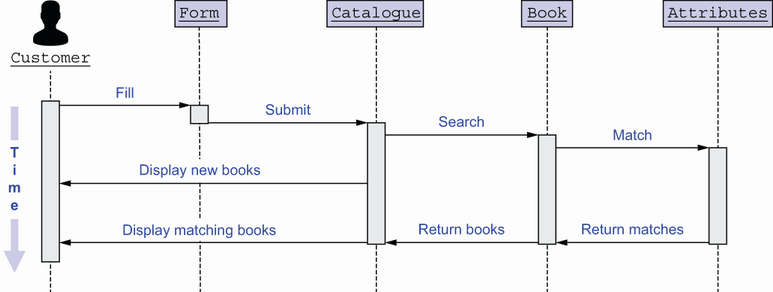
Trace a complete search use case from the customer through Form, Catalogue, Book, and Attributes objects. section 4.6

How Object-Oriented Software Design in C++ covers it

How deep it goes
Defines lifelines, activation rectangles, arrows, and top-to-bottom timing, but does not detail diagram construction notation beyond these elements.
Examples
Uses book searching and cash withdrawal through a hypothetical bank ATM as interaction scenarios.
What it assumes
Assumes familiarity with objects, classes, member functions, and use cases while introducing runtime interaction visualization.
What you can do after
Evaluate class design by tracing whether runtime interactions use appropriate member functions and relationships.
How it connects
Connects objects, member functions, class relationships, use cases, UML class diagrams, and UML state diagrams.

Related concepts

This explainer was generated by Manning's knowledge graph from the text of Object-Oriented Software Design in C++. The section links point to the parts of the book it draws on.